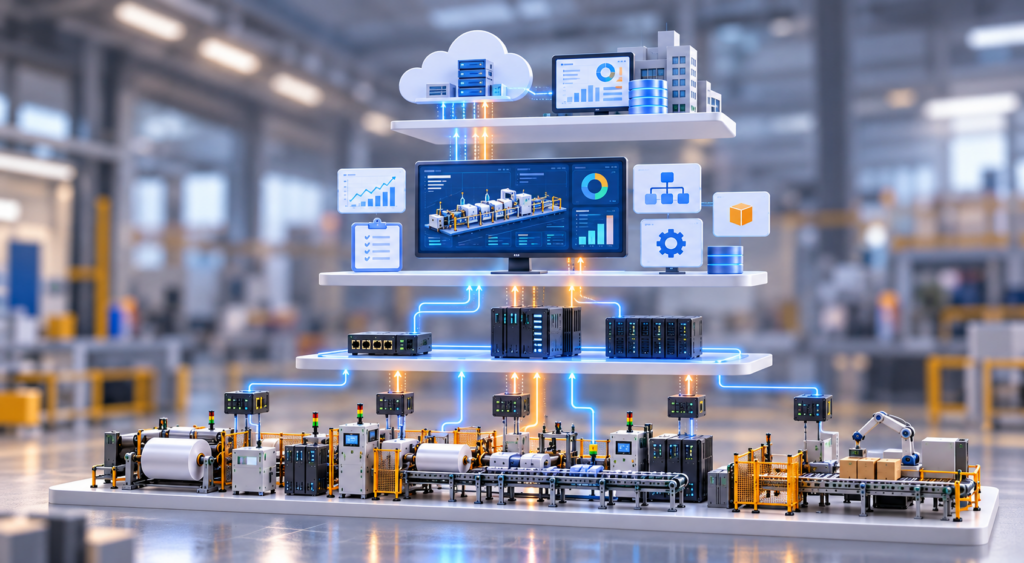

IIot and Edge Computing
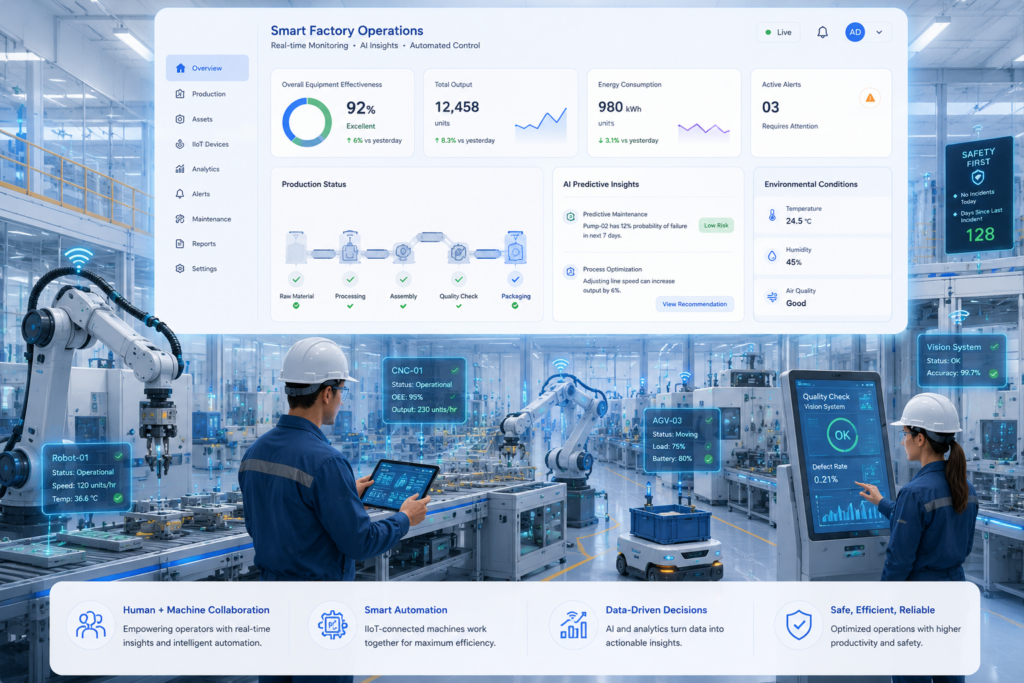
The industrial sector is evolving rapidly. The combination of edge computing and the Industrial Internet of Things (IIoT) gives manufacturers a way to collect, process and act on operational data directly on the plant floor without routing data through a distant data centre.
This post explains what edge computing & IIoT means in practice, why it matters for plant operations and how to implement it in a way that delivers measurable business value.
What Is IIot and Edge Computing?
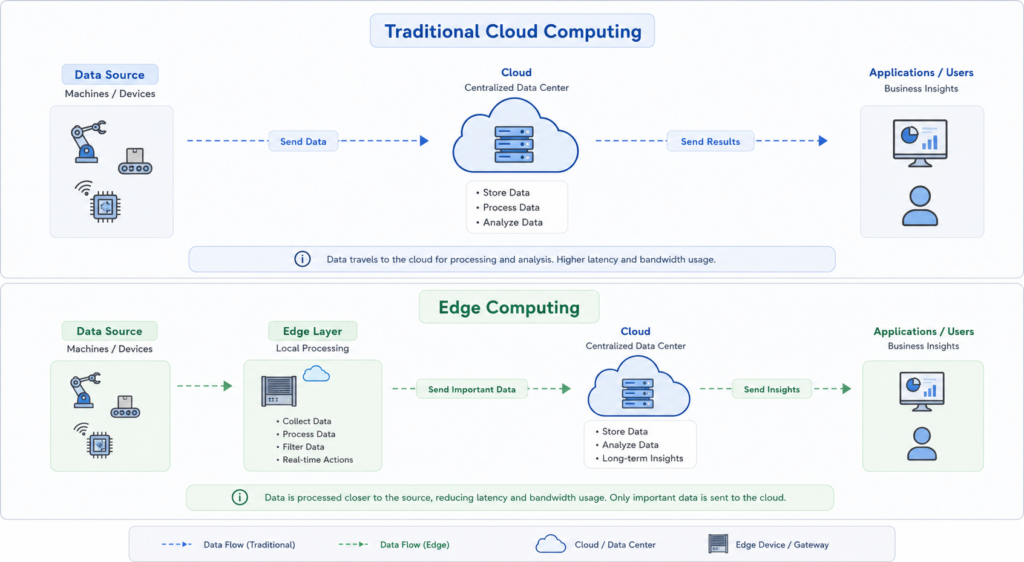
Edge computing moves data processing from centralised cloud servers to devices located close to or directly on the factory floor. In an IIoT context, this means sensor and machine data is analysed locally, rather than sent to a remote platform and back.
Without edge computing, a manufacturing line with hundreds of sensors must send all raw data to the cloud for processing. That round trip adds latency, consumes bandwidth and creates a dependency on network availability. IIot & Edge computing eliminates that round trip by processing data on-site using industrial PCs, gateways or purpose-built edge servers.
These edge devices do more than collect data. They can:
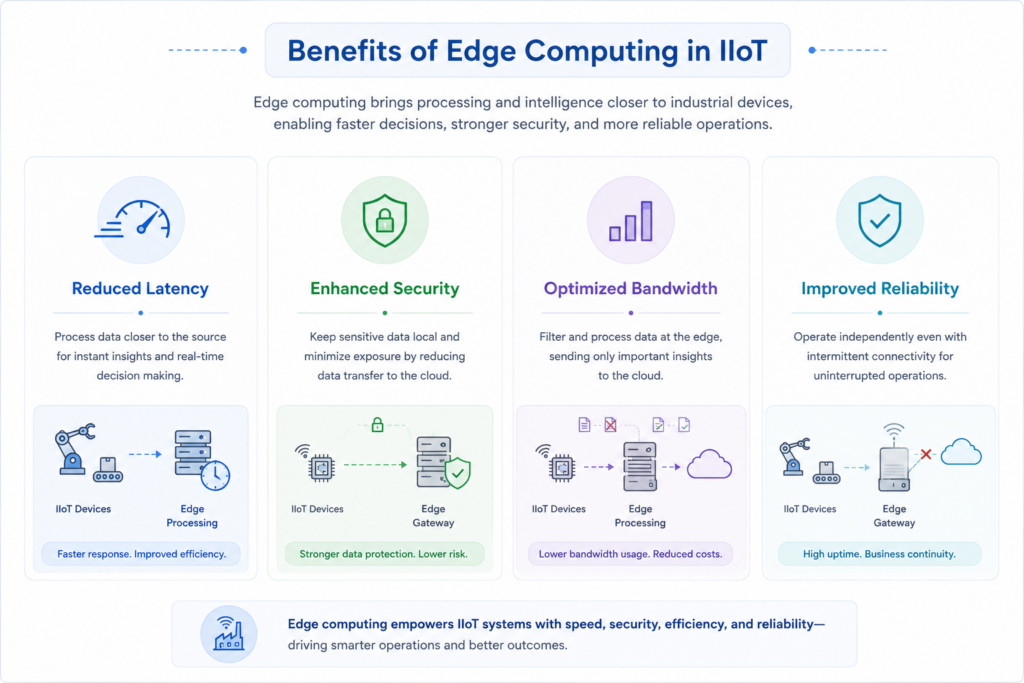
- Run machine learning models to detect anomalies and predict failures in real time
- Issue control commands to machines without waiting for a cloud response
- Filter and compress data before sending it upstream, cutting bandwidth costs substantially
- Continue operating during network outages, keeping production lines stable
- Keep sensitive operational data within the local network, supporting data residency requirements
From an IT perspective, the edge device is the first processing node in your data pipeline. It needs to be specified, secured and governed with that responsibility in mind.
The Business Case for IIot & Edge Computing.
Edge computing delivers returns across five areas that are straightforward to measure and present to leadership:
1. Lower Latency
Cloud processing typically adds 200–500 ms of round-trip delay. Edge processing brings this down to under 5 ms. For closed-loop control systems where a sensor reading must trigger an immediate machine response that difference determines whether a process runs correctly or fails.
2. Reduced Bandwidth and Cloud Costs
A single smart factory can generate several terabytes of sensor data per day. Sending all of it to the cloud is expensive and often unnecessary. Edge devices filter and aggregate data at the source, forwarding only what matters. Organisations typically see 70–85% reductions in WAN data volumes after introducing an edge layer.
3. Predictive Maintenance
Unplanned downtime can cost manufacturers tens of thousands of dollars per hour. Edge devices running ML models on vibration, temperature and current data can identify equipment deterioration days or weeks before failure, allowing maintenance to be scheduled rather than reactive. Early adopters report up to 50% reductions in unplanned downtime.
4. Automated Quality Control
Vision systems with on-device AI can inspect products at full line speed, catching surface defects, dimensional errors and assembly faults faster and more consistently than manual inspection. The result is lower scrap rates, less rework and fewer customer returns.
5. Data Residency and Compliance
Regulations such as GDPR and PDPA impose restrictions on where operational data can be processed and stored. Processing data locally at the edge keeps it within the required jurisdiction, reducing compliance risk without limiting analytical capability.
Business Impact at a Glance:
Business Outcome | Before Edge | After Edge | Impact |
Response Latency | 200–500 ms (cloud) | Under 5 ms (edge) | ~98% reduction |
WAN Data Volume | 100% raw data sent | 5–15% after filtering | ~85% bandwidth saving |
Unplanned Downtime | Reactive repair | Predictive prevention | Up to 50% reduction |
Product Defect Rate | 0.5–2% | Below 0.1% with AI vision | Measurable P&L improvement |
Overall Equipment Eff. | Baseline | Edge analytics applied | 15–20% OEE gain |
Connecting the Plant Floor to Enterprise Systems
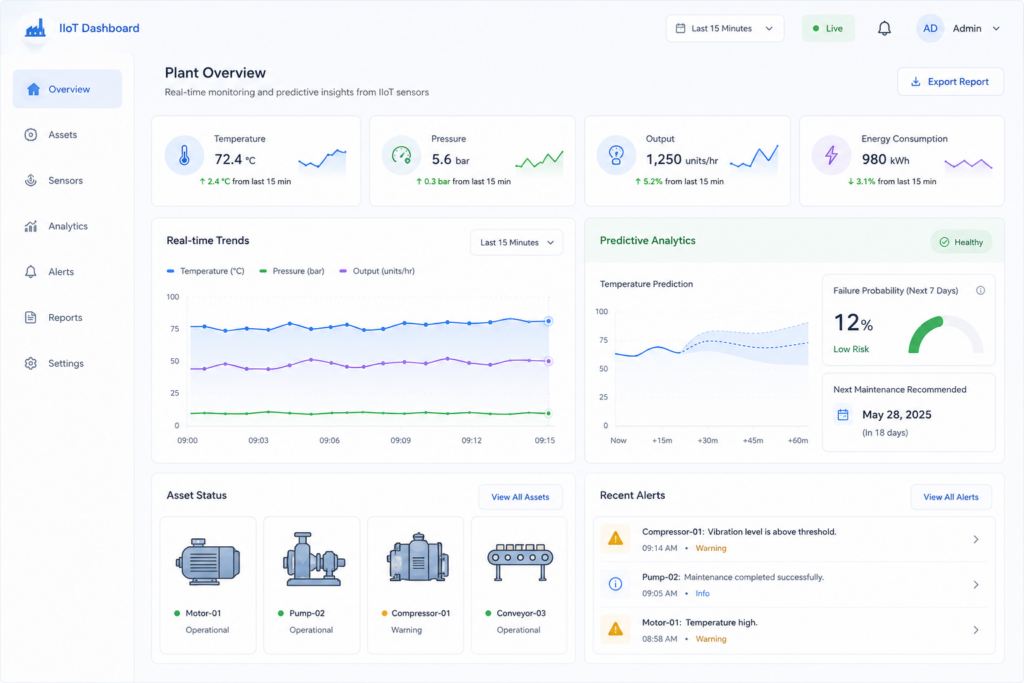
The most common reason IIoT projects fail to deliver value is not the technology but it is poor integration between operational technology (OT) and enterprise IT. Edge devices can generate enormous amounts of useful data but if that data cannot reach your ERP, MES or analytics platform, the investment stalls.
A well-designed IIot & edge computing architecture treats the plant floor as a primary data source within the enterprise not a separate domain. Getting there requires four things:
- Standard protocols: OPC-UA for machine communication; MQTT or AMQP for edge-to-cloud transport; REST APIs for enterprise system integration
- Consistent master data: edge telemetry must use the same asset identifiers, location codes and product references that exist in your ERP and MES, so data can be joined and analysed
- Event-driven pipelines: edge events such as alarms, quality flags and maintenance triggers should publish to a central event bus (such as Kafka or Azure Event Hubs) where business applications can consume them in real time
- Two-way data flow: the edge receives data as well as sends it. Updated ML models, production schedules and configuration changes should flow down from enterprise systems to edge nodes automatically
Edge and Cloud: How They Work Together
Edge computing does not replace the cloud but it complements it. The right architecture divides workloads based on where they are best handled:
- Edge real-time inference, local machine control, anomaly detection, data filtering
- Regional or site tier (optional) aggregation across machines, local data historian, edge model management
- Cloud long-term storage, multi-site analytics, ML model training, ERP and MES integration, reporting
The most effective pattern is train in the cloud, run at the edge. Historical data from multiple sites is used to train predictive models in the cloud. Those models are then packaged and deployed to edge devices, where they run against live sensor data in real time. You get the analytical power of large-scale cloud training with the speed and resilience of local inference.
Data that has been processed and summarised at the edge alerts, KPI summaries, quality reports is then sent to the cloud for longer-term analysis and executive reporting. This keeps cloud data volumes manageable while still giving leadership visibility across all sites.
Implementation Roadmap
Most edge IIoT deployments that fail do so because of governance and organisational issues not technical ones. A phased approach reduces this risk significantly.
Phase 1: Prove Value (Months 1–6)
- Choose one high-value, well-instrumented asset a critical compressor, CNC machine or packaging line
- Deploy edge hardware and connect 3–5 sensor streams
- Implement a single use case: predictive maintenance or quality inspection, not both
- Record baseline KPIs before deployment; review results at 30, 60 and 90 days
- Prepare a business case with measured outcomes before requesting Phase 2 funding
Phase 2: Standardise and Scale (Months 6–18)
- Define a reference architecture and an approved hardware and software stack
- Set IT/OT integration standards and data governance policies
- Roll out to additional assets and production lines
- Build an internal team or centre of practice for edge IIoT operations
Phase 3: Expand and Optimise (Month 18 onwards)
- Add advanced analytics and autonomous control use cases
- Connect edge data to enterprise ML pipelines
- Extend the architecture to logistics and supply chain nodes
- Establish a regular cycle: edge telemetry feeds cloud training, updated models redeploy to edge
Governance Checklist for Edge IIoT
Edge IIoT sits at the boundary of OT and IT a line that has often been governed inconsistently. The table below covers the six areas that cause the most problems when left unaddressed.
Governance Area | Action Item |
Data Ownership | Assign clear OT and IT data stewardship roles before deployment begins. |
Vendor Lock-in | Use open standards (OPC-UA, MQTT) rather than proprietary edge platforms. |
Security Reviews | Audit edge nodes quarterly. Apply the same security standards as enterprise IT. |
Compliance Mapping | Document how edge data flows map to GDPR, PDPA, or applicable sector rules. |
Change Management | Train OT staff on edge tooling early. Bridge the IT/OT skills gap proactively. |
Exit Strategy | Include data portability and migration rights in every edge vendor contract. |
Good governance does not slow down edge adoption. It prevents the kind of technical and compliance debt that makes future scaling expensive or impossible.
Conclusion
IIot & Edge computing gives manufacturers the ability to act on operational data in real time, directly on the plant floor. The benefits lower latency, reduced costs, predictive maintenance, better quality control and stronger compliance are measurable and increasingly well-documented across the industry.
The technology is mature enough to deploy now. The challenge is not whether it works. It is how to implement it in a way that integrates with existing enterprise systems, meets governance requirements and scales beyond the first pilot.
Start with one asset, one use case and a clear measurement plan. Build the governance framework in parallel. The organisations that do this systematically today will have a meaningful operational advantage as edge intelligence becomes standard across manufacturing.
Reference:
https://www.ibm.com/think/topics/iot-edge-computing
https://www.portainer.io/blog/industrial-edge-computing
https://www.chipsgate.com/blogs/news/industrial-edge-computing-iiot