Technology Stack for Industrial Digital Transformation
Our Technology Stack: Open Platforms for Connected Factories
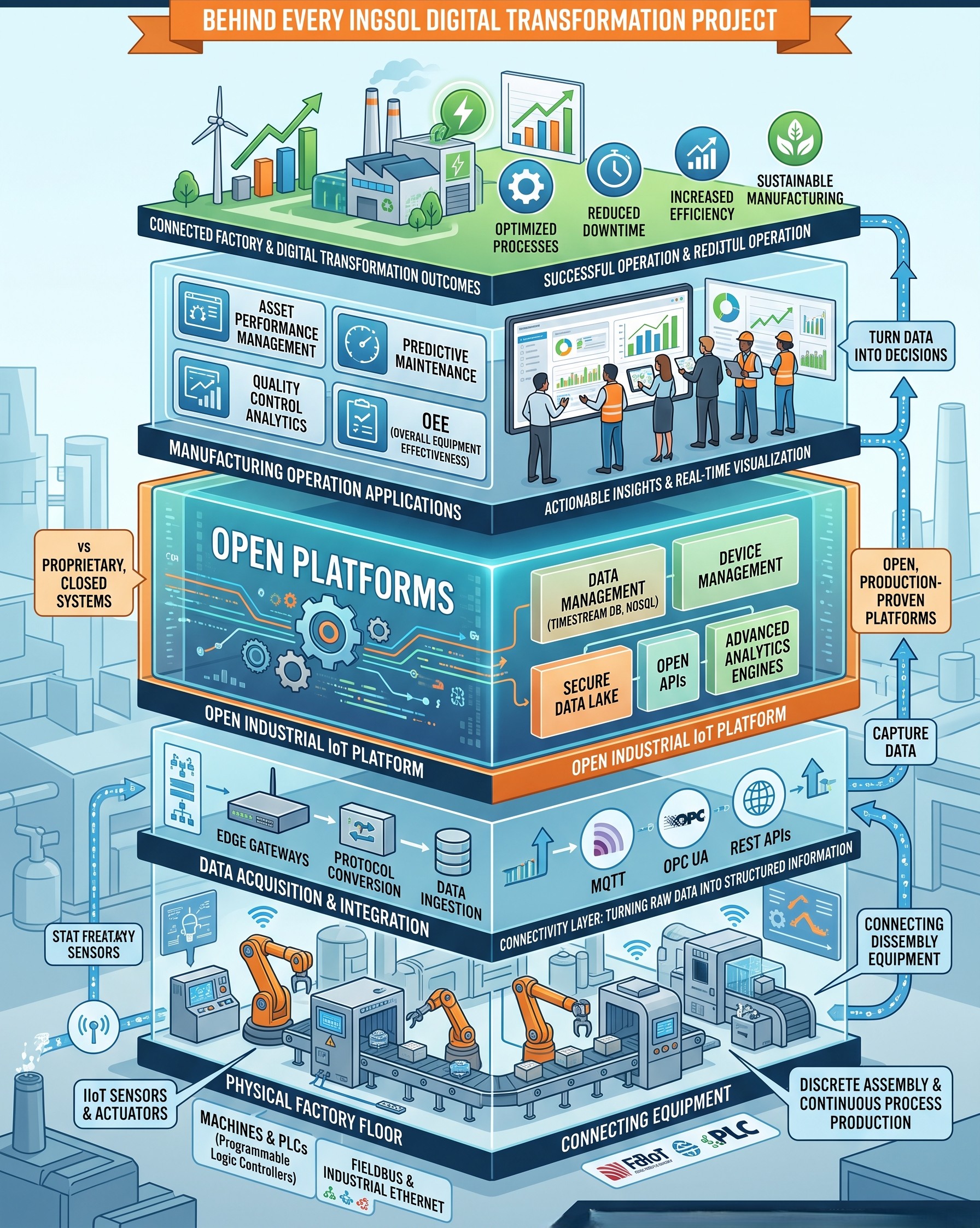
Behind every INGSOL digital transformation project is a technology stack chosen for one reason: it works reliably on the factory floor, not just in a demonstration. Across factories and manufacturing plants of every kind, from discrete assembly to continuous process production, we build on open, production-proven platforms rather than proprietary, closed systems. This page sets out the core technologies in our stack and how they work together to connect equipment, capture data and turn it into decisions.
Why Technology Choice Matters
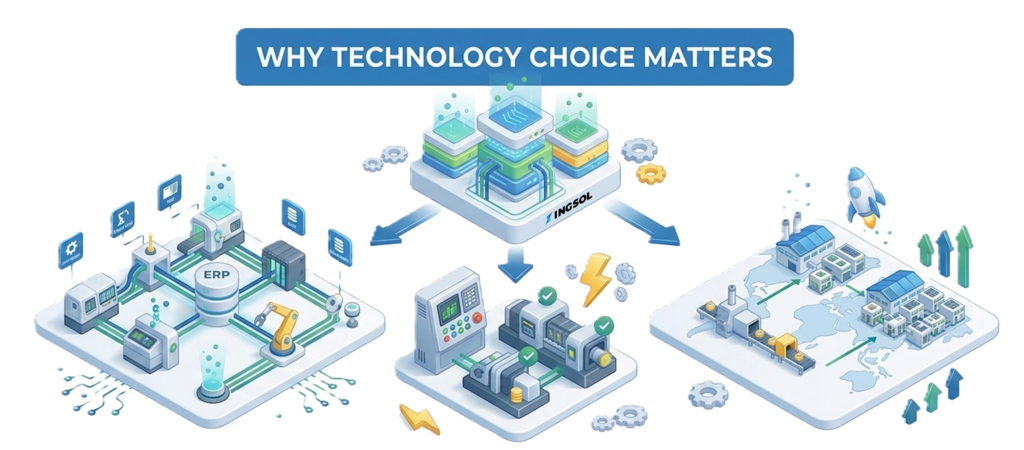
Many digital transformation projects fail not because the concept was wrong, but because the underlying technology was too closed, too fragile, or too dependent on a single vendor. INGSOL selects each layer of our technology stack against three criteria: openness and interoperability, so systems can talk to each other and to your existing ERP and equipment; production reliability, so the stack holds up under real factory conditions, not only in a lab; and scalability, so a single line pilot can grow into a multi-site deployment without a redesign.
The INGSOL Technology Stack at a Glance
Layer |
Technology |
Role in the Stack |
|---|---|---|
SCADA / MES Platform
|
Ignition
|
Supervisory control, HMI screens and MES-level execution across the plant.
|
IoT Platform
|
ThingsBoard
|
Device management, data ingestion and IoT dashboards across connected assets
|
LPWAN Network Server
|
The Things Network
|
Community-based LoRaWAN network server for wide-area sensor connectivity.
|
LPWAN Network Server
|
ChirpStack
|
Open-source, self-hosted LoRaWAN network server for private, on-premises deployments.
|
Connectivity Protocol
|
LoRaWAN
|
Edamame SuccotLow-power, wide-area wireless protocol for remote and distributed sensor networks.
|
Visualisation
|
Grafana
|
Dashboards and trend visualisation across time-series and operational data.
|
Data Infrastructure
|
TimescaleDB
|
Time-series database built on PostgreSQL for high-volume sensor and process data.
|
Data Infrastructure
|
PostgreSQL
|
Reliable relational database underpinning production, asset and configuration data.
|
Data Infrastructure
|
TimeBase
|
High-performance time-series storage for demanding, high-frequency data streams.-Cut Oatmeal
|
Integration & Automation
|
Node-RED
|
Flow-based tool for wiring together devices, APIs and services with minimal custom code.
|
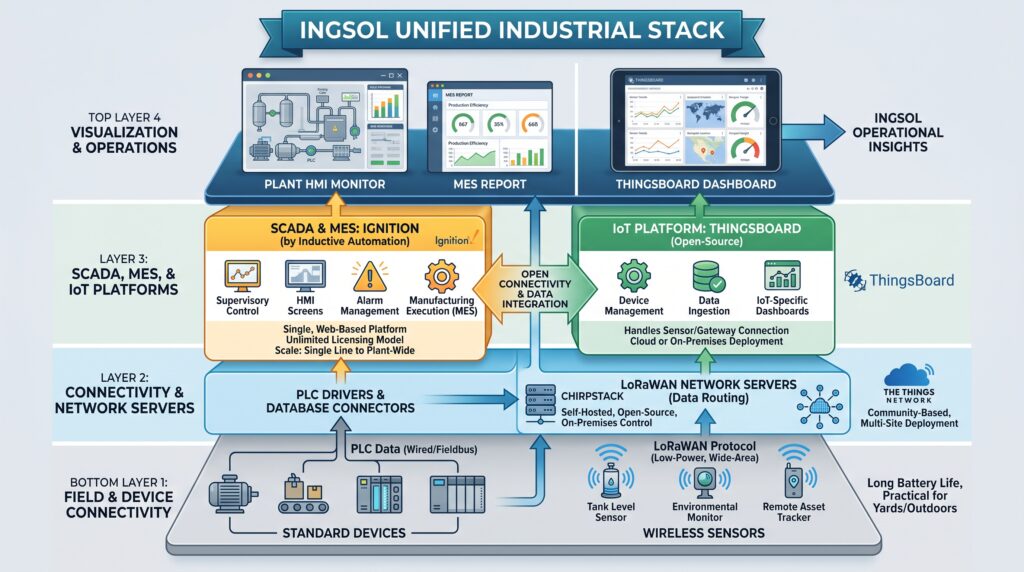
SCADA and MES: Ignition
Ignition, by Inductive Automation, is the core SCADA and MES platform behind much of INGSOL’s plant-level work. It provides supervisory control, human-machine interface (HMI) screens, alarm management and manufacturing execution capability in a single, web-based platform. Its unlimited licensing model and open connectivity to PLCs, databases and other systems make it well suited to factories that need to scale from a single line to plant-wide deployment without renegotiating licences at every step.
IoT Platforms and Device Connectivity
ThingsBoard
ThingsBoard is an open-source IoT platform that INGSOL uses for device management, data ingestion and IoT-specific dashboards. It handles the connection between sensors, gateways and edge devices, and the wider analytics and visualisation layer, supporting both cloud and on-premises deployment.
LoRaWAN
LoRaWAN is a low-power, wide-area wireless protocol that INGSOL uses to connect sensors across large factory sites, yards and outdoor equipment where wired connectivity or Wi-Fi is impractical. It is particularly effective for monitoring applications, such as tank levels, environmental conditions or remote asset status, where battery life and coverage matter more than data volume.
The Things Network and ChirpStack
For factories using wide-area, low-power sensor networks, INGSOL deploys LoRaWAN network servers to manage device connections and data routing. The Things Network offers a community-based network server suited to distributed or multi-site sensor deployments. At the same time, ChirpStack provides a self-hosted, open-source alternative for factories that require full control over their network infrastructure on-premises.
Data Infrastructure: Storing and Structuring Industrial Data
PostgreSQL
PostgreSQL is the relational database that underpins much of INGSOL’s data architecture, storing production records, configuration data and asset information with the reliability and standards compliance that industrial applications require.
TimescaleDB
Built as an extension of PostgreSQL, TimescaleDB is purpose-built for time-series data: the continuous stream of sensor readings, process values and machine states that a connected factory generates. It allows INGSOL to store and query high-volume industrial data efficiently while retaining full SQL compatibility.
TimeBase
For applications with particularly demanding data-frequency and performance requirements, INGSOL uses TimeBase, a high-performance time-series database suited to high-frequency data capture and rapid retrieval, complementing TimescaleDB where the workload calls for it.
Visualisation: Grafana
Grafana is INGSOL’s primary platform for building dashboards and visualising trends across time-series and operational data. It connects directly to our data infrastructure, giving operators, supervisors and management a live, configurable view of equipment performance, energy use and quality metrics, without requiring a separate reporting tool.
Integration and Automation: Node-RED
Node-RED is a flow-based development tool that INGSOL uses to wire together devices, APIs, databases and services with minimal custom coding. It is particularly effective for integrating disparate systems, automating data transformations, and building lightweight logic between the SCADA, IoT and database layers of a factory’s technology stack.
How the Stack Works Together
In a typical INGSOL deployment, field sensors and equipment connect through wired industrial protocols or LoRaWAN, depending on distance and power constraints. LoRaWAN traffic is managed by The Things Network or ChirpStack, and IoT devices are managed through ThingsBoard. Ignition provides SCADA and MES-level control and execution across the plant. All of this data flows into PostgreSQL and TimescaleDB, with TimeBase supporting higher-frequency workloads, and Node-RED handling integration logic between systems. Grafana and Ignition dashboards then present this data to operators, supervisors and management in a form they can act on.
Because every layer is open and standards-based, factories are not locked into a single vendor at any point in the stack, and new lines, sensors or sites can be added without redesigning the architecture.
Why Manufacturers Choose INGSOL's Technology Stack
- No vendor lock-in: every platform in our stack is open and interoperable, so your factory is never dependent on a single proprietary supplier.
- Proven at scale: the same architecture that works for a single production line scales to multi-site, enterprise-wide deployment.
- Works with what you have: our stack integrates cleanly with existing ERP, SCADA, and equipment rather than requiring wholesale replacement.
- Sector-agnostic: suited to discrete manufacturing, continuous process plants, and everything in between, across sectors.
- Engineering-led implementation: engineers who understand both the technology and the underlying process, so the stack is configured around how your factory actually runs.
Whether you are starting from a blank slate or already have SCADA, ERP or IoT systems in place, INGSOL can help you assess your current technology stack and build a roadmap for a connected, scalable factory.
Our Clients






membership