

IIoT Is Revolutionizing Predictive Maintenance
Unplanned downtime costs manufacturers an estimated $50 billion per year. In 2026, Industrial IoT is finally delivering on its promise and predictive maintenance is leading the charge. Whether you operate a single facility or a global network of plants, understanding this shift could determine your competitive edge for the next decade.
In this post, we’ll break down exactly how IIoT predictive maintenance works, why 2026 marks a genuine tipping point, and how manufacturers of all sizes are turning sensor data into serious ROI.
What Is IIoT Predictive Maintenance?
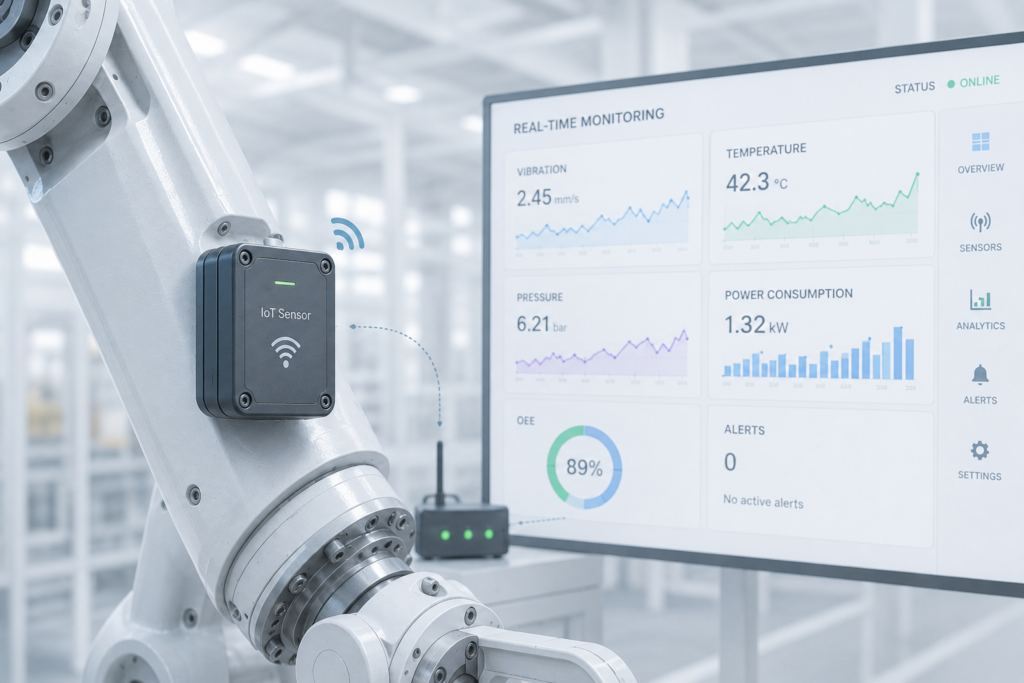
IIoT predictive maintenance uses real-time sensor data from industrial machines to detect failure patterns before breakdowns occur. Unlike traditional time-based maintenance (“service every 90 days”) or reactive maintenance (“fix it when it breaks”), predictive maintenance acts only when data signals a real risk.
The result: dramatically less unplanned downtime, fewer unnecessary parts replacements and maintenance teams that spend their hours on actual problems not on calendar-driven check-ins that may not be needed.
At its core, IIoT predictive maintenance brings together three technologies: industrial sensors, edge computing and AI-powered anomaly detection. Each plays a distinct role in the data pipeline from machine to maintenance team.
Yet, this efficiency hides a deep, systemic paradox: the very properties that make flexible packaging so outstanding for product protection also make it incredibly difficult to recycle. Traditional waste management facilities are designed for rigid, uniform containers. When lightweight, flexible films enter a standard materials recovery facility (MRF), they behave like paper, clogging sorting machinery, slipping past optical sensors or ending up misclassified in landfill-bound residues.
To bridge this gap a technological revolution is quietly taking place. Smart packaging technology is stepping in to redefine how we identify, sort and process waste. By embedding digital intelligence directly into the material structure, the packaging industry is transforming from a linear footprint into an active, trace-and-sort circular economy participant.
Why 2026 Is the Tipping Point
Predictive maintenance has been talked about for nearly a decade. So what makes 2026 different? Three forces are converging at the same time:
- Edge computing costs have dropped over 60% since 2020, making on-site data processing viable for mid-market manufacturers
- 5G industrial connectivity now reaches the majority of manufacturing facilities in North America, Europe and parts of Asia
- AI anomaly-detection models have matured enough to run on-device, eliminating the latency of cloud-based analysis
Together, these developments make predictive maintenance practical not just possible. For the first time, you don’t need a Fortune 500 IT budget to deploy it effectively.
How It Works in Practice
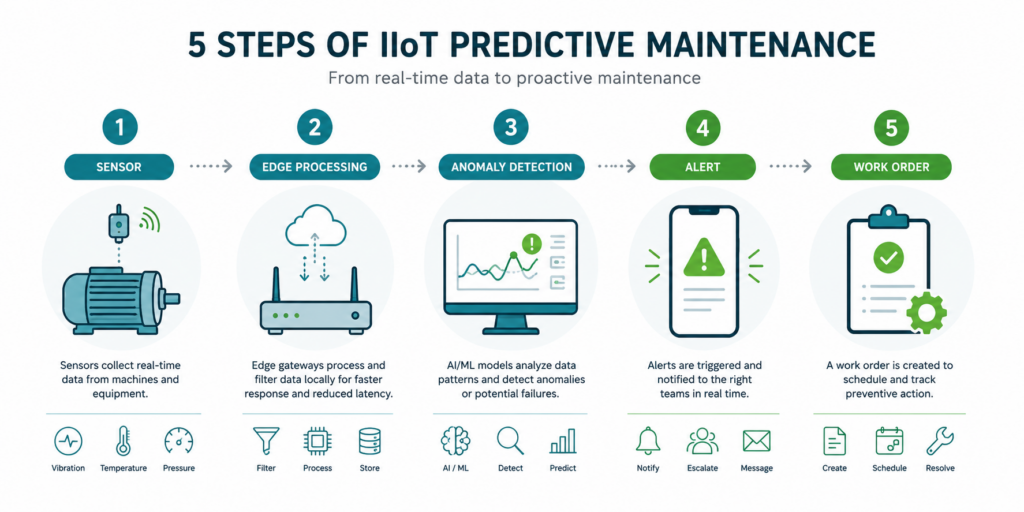
Step 1 Sensors capture machine health signals: Vibration, temperature, electrical current draw, pressure and acoustic emissions are monitored continuously. Modern IIoT sensors sample hundreds of data points per second and consume minimal power.
Step 2 Edge devices pre-process the data: Rather than sending raw data to the cloud (slow, expensive, and bandwidth-intensive), an edge computing device installed locally filters and compresses signals in real time. Anomalies are flagged instantly.
Step 3 AI models identify failure signatures: Machine learning models trained on thousands of historical failure events recognize the early signatures of bearing wear, motor overheating, lubrication failure, and dozens of other fault types often days or weeks before the machine would fail.
Step 4: Alerts reach the right people instantly: Maintenance alerts are delivered to technicians’ mobile devices in under 30 seconds. When integrated with your Manufacturing Execution System (MES) or ERP work orders can be auto-generated and parts can be pre-ordered all without manual intervention.
Measuring the ROI
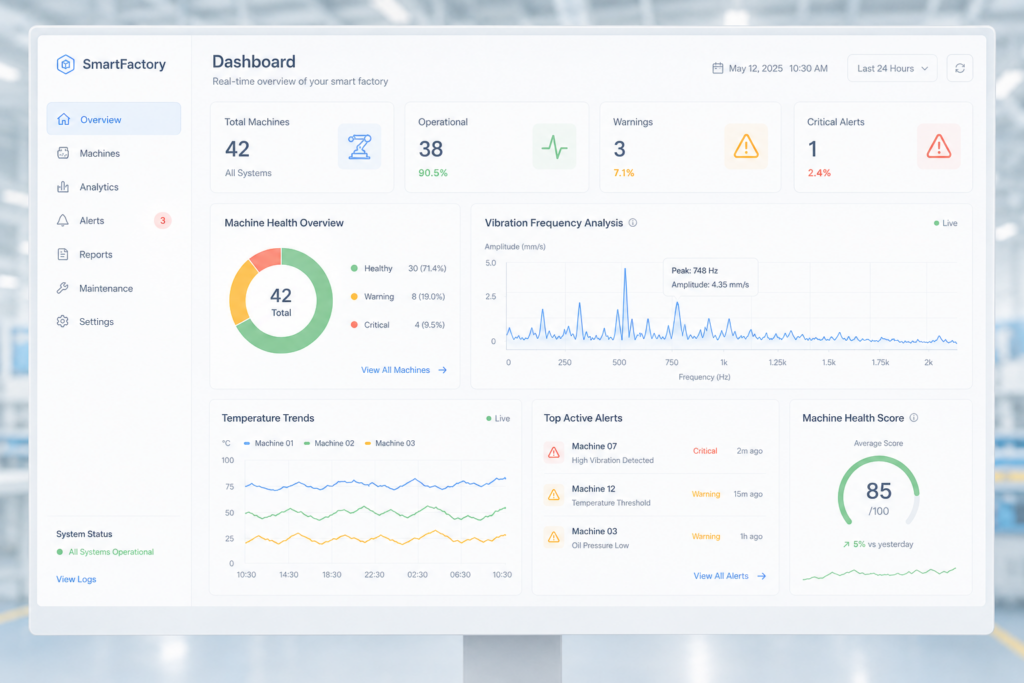
The business case for IIoT predictive maintenance is now well-documented. Early adopters across automotive, food processing and heavy industry are reporting:
- 30–45% reduction in unplanned downtime within the first 12 months
- 20% lower annual maintenance spend by eliminating unnecessary scheduled interventions
- 15–25% improvement in Overall Equipment Effectiveness (OEE)
- Payback period of under 2 years for a mid-sized facility
According to industry reports, the global predictive maintenance market is projected to exceed $28 billion by 2026, with manufacturing accounting for the largest share of adoption.
Getting Started: A Practical Roadmap

The most common mistake manufacturers make is trying to deploy sensors on every machine at once. Don’t. Here’s a smarter approach:
Start with your highest-criticality assets, the machines whose failure would immediately halt production or cause a safety incident. Deploy sensors, run the system for 60–90 days and let the data teach you what ‘normal’ looks like for each asset.
From there, expand systematically. Most facilities achieve full-floor deployment within 18–24 months, with the data from early deployments directly informing the ROI case for each subsequent phase.
When evaluating IIoT platforms, prioritize open-protocol sensor compatibility, native MES/ERP integration and edge-first architecture. Proprietary lock-in is the single biggest risk in long-term deployments.
Conclusion
IIoT predictive maintenance is no longer a future-state concept reserved for well-resourced enterprises. In 2025, the technology, the infrastructure, and the ROI evidence are all in place. The manufacturers who move now will build operational advantages that compound over years.
Ready to build your IIoT roadmap?
Download our free predictive maintenance starter guide or speak with a specialist to assess your facility’s readiness today.
Reference:
https://www.siemens.com/global/en/products/services/digital-enterprise-services/predictive-maintenance.html
https://www.ibm.com/think/topics/predictive-maintenance
https://iot.ieee.org/