

How Smart Packaging Technology: Reshaping Flexible Packaging Sorting
Flexible packaging uses far less material than rigid alternatives, cutting transport emissions and extending product shelf life. But its lightweight, multi-layer structure makes it a nightmare for standard recycling facilities to sort and process. A quiet technological revolution is underway, with smart packaging embedding digital intelligence directly into materials. This is pushing the industry toward a truly circular economy where packaging can be traced, sorted, and recovered.
The Flexible Packaging Paradox
Flexible packaging is a triumph of modern engineering. From stand-up food pouches to lightweight cosmetic sachets, it requires up to 70% less material than rigid plastic, glass or metal alternatives. By drastically reducing packaging weight, it minimizes transportation emissions and cuts overall food waste by extending shelf life.
Yet, this efficiency hides a deep, systemic paradox: the very properties that make flexible packaging so outstanding for product protection also make it incredibly difficult to recycle. Traditional waste management facilities are designed for rigid, uniform containers. When lightweight, flexible films enter a standard materials recovery facility (MRF), they behave like paper, clogging sorting machinery, slipping past optical sensors, or ending up misclassified in landfill-bound residues.
To bridge this gap a technological revolution is quietly taking place. Smart packaging technology is stepping in to redefine how we identify, sort, and process waste. By embedding digital intelligence directly into the material structure, the packaging industry is transforming from a linear footprint into an active, trace-and-sort circular economy participant.
The Blind Spot of Modern Recycling: Why Flexibles Fail
To understand why smart packaging technology is necessary, we must first analyze the bottlenecks of modern mechanical recycling. Standard MRFs utilize a combination of manual labor, magnets, trommels (rotating screen drums), and standard Near-Infrared (NIR) optical sorters. While NIR sensors are highly effective at distinguishing rigid High-Density Polyethylene (HDPE) from Polyethylene Terephthalate (PET), they struggle immensely with flexible packaging sorting.
The reasons are threefold:
- Multi-Material Composition: Many flexible pouches are laminated sandwiches of different plastics (e.g., PET, PE, PP) and aluminium foil. The NIR scanner reads only the outermost layer, misidentifying the true composition of the underlying laminate structure.
- 3D Geometry and Flatness: Flexible films are easily crushed, folded, or covered in organic residue. When they pass under high-speed optical sorters, their flat, deformed shape does not present a consistent surface for scanners, leading to read errors.
- Cross-Contamination: Food-contact flexible packaging often retains oils, fats, and organic material. In the absence of detailed sorting criteria, these materials are bundled into low-grade plastic mixes that cannot be reused in food-safe applications.
As global regulations tighten most notably the European Union’s Packaging and Packaging Waste Regulation (PPWR) coming into full force on August 12, 2026, doing nothing is no longer an option. The industry must move beyond simple structural redesigns and adopt intelligent, data-driven systems.
Enter the Digital Watermark: The Technology Behind HolyGrail 2.0
At the forefront of this digital revolution is the concept of digital watermarks packaging. Backed by the landmark European initiative “HolyGrail 2.0,” digital watermarks are postage-stamp-sized codes applied directly to the surface of the package.
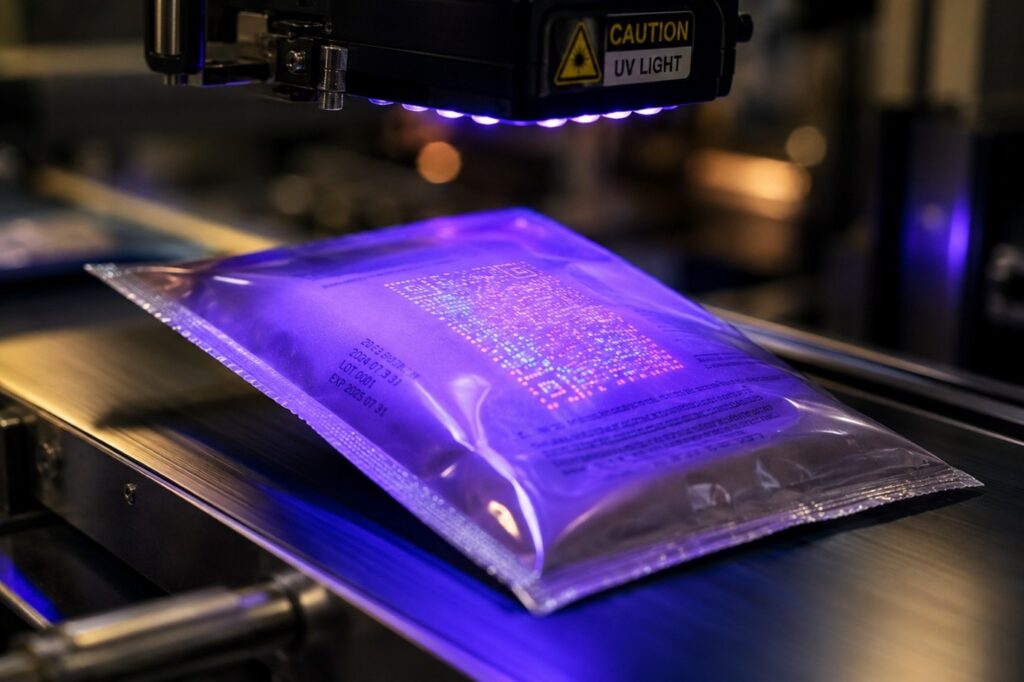
Unlike traditional QR codes or barcodes, these digital watermarks are invisible to the naked human eye. They are integrated into the packaging artwork or embossed directly into the plastic mould during production. To a consumer, the package looks completely normal. However, to a high-speed camera mounted on an industrial sorting conveyor, the watermark is a vibrant, unmistakable beacon of data.
How It Works on the Sorting Line:
As mixed waste rushes down a conveyor belt at speeds exceeding 3 meters per second, high-resolution cameras equipped with specialized LED lighting detect the subtle, repeating pixel pattern of the digital watermark. Within milliseconds, the system decodes the watermark, extracting critical data points such as:
- The exact polymer type (e.g., Mono-PE, Mono-PP, or barrier layers).
- Whether the packaging was used for food or non-food applications (crucial for maintaining food-grade recycling streams).
- The parent brand and specific product stock-keeping unit (SKU).
- The precise geographic market origin (helping calculate exact Extended Producer Responsibility fees).
Once decoded, a pneumatic air jet instantly blasts the targeted flexible pouch off the main conveyor and into its highly specific, dedicated recycling chute. This achieves sorting purity levels exceeding 95%, a feat previously thought impossible for flexible plastic packaging.
The AI Sorting Brain: Computer Vision in Waste Management
While digital watermarks provide the target, artificial intelligence acts as the brain. The integration of AI in recycling is transforming how materials recovery facilities operate. By pairing high-definition cameras with deep learning computer vision models, sorting systems can identify flexible packaging even when it is dirty, torn, or crumpled.
AI models are trained on millions of images of crushed pouches, tubes, and films. Through continuous learning, these systems develop a nuanced understanding of packaging shapes, branding designs, and material behaviours.
Complementary Coexistence: AI + Watermarks
The true magic happens when computer vision and digital watermarks work in tandem. If a package’s watermark is partially obscured by grease or dirt, the AI system uses its visual context (the shape of the pouch, the surviving brand typography, the colour palette) to predict the material composition with high accuracy.
Furthermore, AI tracking systems generate real-time analytics for MRF operators. They can monitor the volume of flexible packages flowing through the plant, identify shifts in material composition, and instantly flag contamination hotspots before they ruin a batch of high-purity recycled resins.
The Economic and Regulatory Push: The 2026 Shift
The adoption of smart packaging technology is not merely a philanthropic endeavour; it is a regulatory and economic necessity. Under the impending PPWR framework, every packaging format placed on the EU market must be certified as “recyclable at scale” by 2030. In practice, this means brands will face severe financial penalties or complete market exclusion if they fail to prove their packaging is actively being collected and sorted.
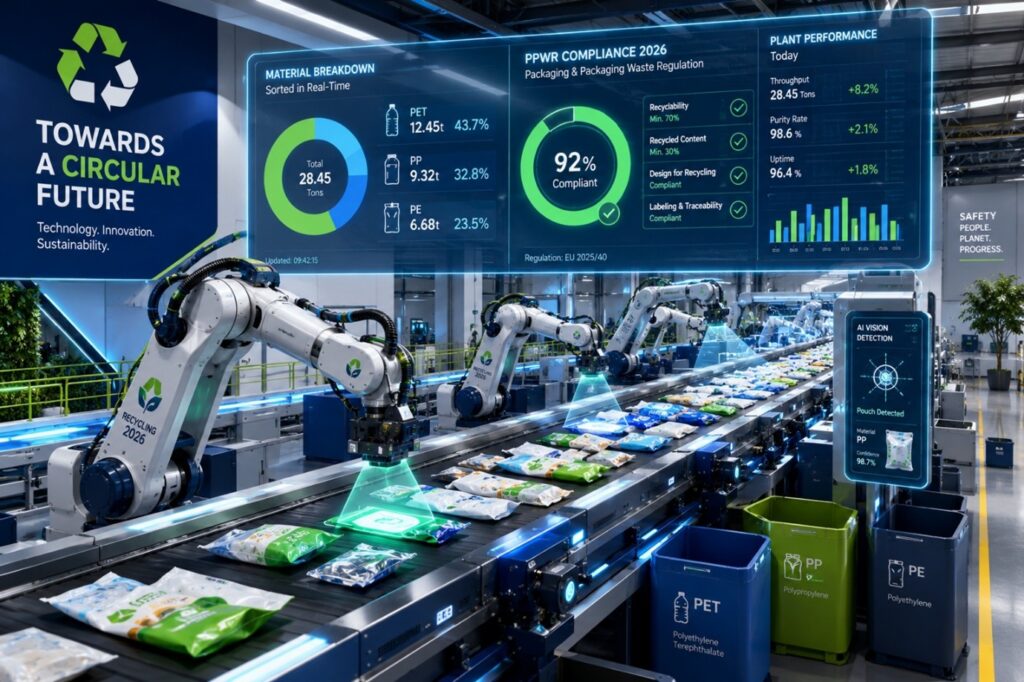
Eco-Modulated EPR Fees: The Carrot and the Stick
Extended Producer Responsibility (EPR) schemes are transitioning to “eco-modulated” fee structures. Under this system:
- Low-Recyclability Packaging: Complex, multi-material flexible films that cannot be mechanically sorted will face exceptionally high compliance fees.
- Smart, Circular Packaging: Mono-material flexible pouches equipped with digital watermarks that actively facilitate clean separation will enjoy significantly reduced EPR rates.
For multi-national consumer goods brands, this delta represents millions of dollars in annual operating costs. Investing in smart packaging technology is quickly transforming from an R&D experiment into a vital protective strategy for brand balance sheets.
Actionable Implementation Guide for Brands
For consumer packaged goods (CPG) companies ready to lead the transition into smart packaging technology, the path to implementation requires strategic, cross-departmental alignment.
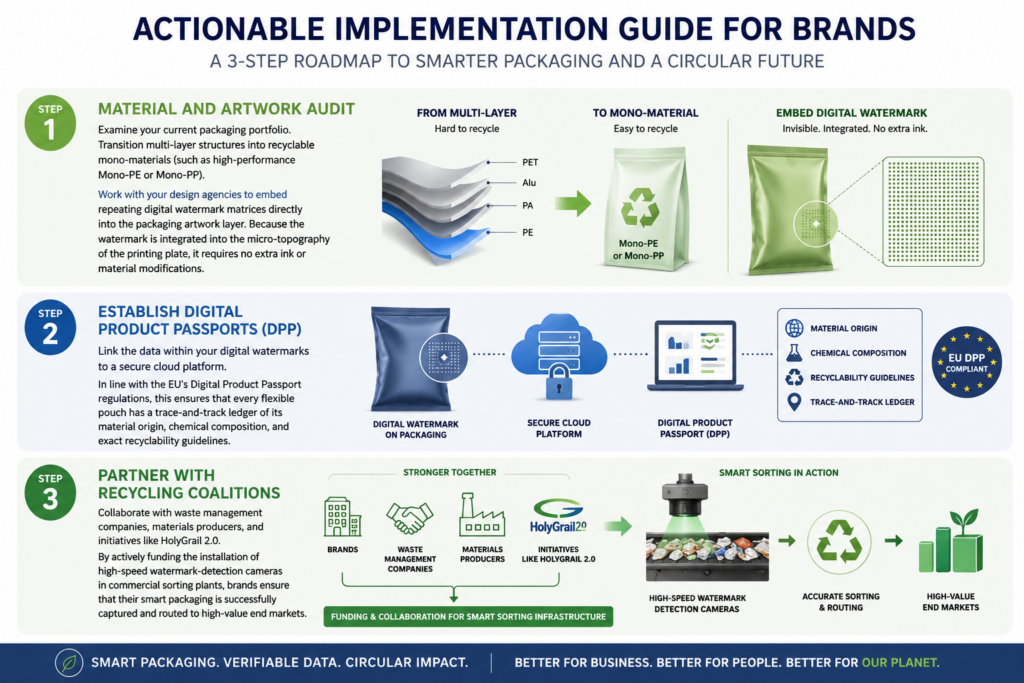
Step 1: Material and Artwork Audit
Examine your current packaging portfolio. Transition multi-layer structures into recyclable mono-materials (such as high-performance Mono-PE or Mono-PP). Work with your design agencies to embed repeating digital watermark matrices directly into the packaging artwork layer. Because the watermark is integrated into the microtopography of the printing plate, it requires no extra ink or material modifications.
Step 2: Establish Digital Product Passports (DPP)
Link the data within your digital watermarks to a secure cloud platform. In line with the EU’s Digital Product Passport regulations, this ensures that every flexible pouch has a trace-and-track ledger of its material origin, chemical composition, and exact recyclability guidelines.
Step 3: Partner with Recycling Coalitions
Collaborate with waste management companies, materials producers, and initiatives like HolyGrail 2.0. By actively funding the installation of high-speed watermark-detection cameras in commercial sorting plants, brands ensure that their smart packaging is successfully captured and routed to high-value end markets.
Conclusion
The days of passive, “hopeful” recycling are coming to a close. The future of flexible packaging relies entirely on our ability to make it smart. By merging the structural advantages of flexible packaging sorting with the digital power of watermarks and artificial intelligence, we can build a packaging ecosystem that is lightweight, highly functional and truly circular.
For brands, manufacturers and consumers alike, the message is clear: packaging must no longer just protect the product but it must also carry the data required to save itself.
Are you ready to design the packaging of tomorrow? Partner with our packaging and digital engineering specialists today to audit your current designs, implement smart watermark systems, and secure your place in the upcoming circular economy.
Reference:
https://www.youtube.com/watch?v=0PwAjAuV–U
https://packagingeurope.com/news/use-of-digital-watermarks-validated-for-advanced-sorting-of-flexibles-through-industrial-trials/11799.article
https://www.greiner-gpi.com/en/Products/Product-innovations/Digital-Watermarks