Our Vision for a Human-Centric Industry 5.0
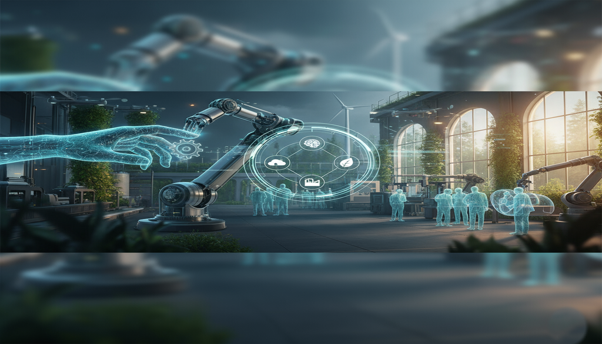
At INGSOL, we see Industry 5.0 as the next frontier of human-centric, sustainable, and resilient manufacturing. Our approach focuses on integrating advanced technologies from AI and collaborative robots (cobots) to digital twins and Industrial IoT with human creativity and operational expertise.
We emphasize workforce empowerment, helping teams upskill for the future while leveraging technology to enhance productivity, safety, and innovation. Sustainability is central to our methodology, guiding green manufacturing practices, waste reduction, and energy-efficient solutions across every stage of production.
By combining smart technologies with human ingenuity, INGSOL helps industries transition from purely automated systems to collaborative, adaptive, and future-ready operations, ensuring businesses remain competitive while contributing to societal and environmental goals.
Introduction to Industry 5.0

Industry 4.0 was a game-changer, bringing automation, IoT, AI, and big data into the heart of production. It gave rise to smart factories where machines could “talk” to each other, predictive maintenance minimized downtime, and supply chains became increasingly agile. For instance, Siemens and General Electric leveraged IoT-powered platforms to optimize efficiency and reduce costs dramatically.
But as impressive as it was, Industry 4.0 also raised concerns about job losses, human alienation, and environmental consequences. The focus leaned too heavily on automation, side lining the very people who give industries their heart and soul.
That’s where Industry 5.0 steps in. Coined by the European Commission in 2021, it doesn’t discard the advancements of Industry 4.0 but balances them with human values: creativity, ethics, empathy, and sustainability. Instead of chasing efficiency alone, it promotes resilience, personalization, and environmental stewardship. In short, Industry 5.0 is about prosperity beyond profits, ensuring businesses not only grow but also enrich society and protect our planet.
Key Principles of Industry 5.0

Industry 5.0 rests on three core pillars that set it apart from its predecessors:
1. Human-Centricity
The human workforce is not just included, it’s placed at the centre of innovation. This means designing systems that augment human skills rather than erasing them. AI tools and ergonomic designs reduce physical strain, enabling workers to focus on creative problem-solving and strategic decision-making.
Beyond efficiency, human-centricity creates inclusive workforces, supporting diversity and accessibility for example, adaptive technologies that empower employees with disabilities. This principle isn’t just ethical; it’s strategic, as industries that value people attract talent, improve morale, and drive long-term competitiveness.
2. Sustainability
With climate change at the forefront, Industry 5.0 embeds eco-friendly practices into the industrial core. By embracing circular economy models, companies minimize waste, recycle resources, and reduce emissions.
For example, renewable energy integration in factories not only lowers carbon footprints but also cuts operational costs by up to 30%. Sustainability is no longer just compliance, it’s a business advantage that strengthens customer trust and future-proofs industries.
3. Resilience
If the pandemic taught us anything, it’s that industries need resilience against global shocks. Industry 5.0 promotes flexible systems, modular production lines, and AI-powered forecasting tools to prepare for disruptions.
Digital twins, for instance, allow companies to simulate challenges from supply chain delays to equipment failures and identify the best responses in real-time. Resilience ensures continuity, economic stability, and worker security in an uncertain world.
The Role of Human–Machine Collaboration

The defining feature of Industry 5.0 is collaboration instead of competition between humans and machines. While Industry 4.0 leaned on robots replacing human tasks, Industry 5.0 embraces cobots- collaborative robots designed to work side by side with people.
These cobots are equipped with sensors, AI, and adaptive learning capabilities, helping with tasks like assembly, inspection, and repetitive labour, while humans bring creativity, intuition, and innovation to the table.
Real-world examples highlight this synergy:
1. Aerospace: Cobots handle precise welding, while engineers oversee complex design integrations.
2. Healthcare: AI supports diagnostics, while doctors focus on empathy-driven patient care.
3. Automotive: Personalized “lot size one” vehicles are possible, combining AI optimization with human customization.
4. Fashion: AI analyzes patterns for efficiency, while artisans add unique creative touches.
This collaboration boosts productivity by 20–30%, but equally important, it makes work more fulfilling and human-centred.
Technologies Driving Industry 5.0

Several breakthrough technologies fuel Industry 5.0’s growth:
1. Artificial Intelligence & Machine Learning (AI/ML): Predictive analytics, adaptive learning, and personalized recommendations.
2. Collaborative Robots (Cobots): Safe, flexible, and human-aware robots that learn on the go.
3. IoT & IIoT: Real-time device connectivity for smart monitoring and supply chain optimization.
4. Extended Reality (AR/VR): Immersive training, reducing training time by 40%.
5. Digital Twins: Virtual replicas for safe testing, scenario planning, and optimization.
6. Big Data & Block chain: Secure, transparent insights across supply chains.
Together, these technologies create a seamless human-machine ecosystem, amplifying innovation while reducing risks.
Sustainability and Green Manufacturing

Industry 5.0 doesn’t just reduce emissions, it redefines sustainability. From AI-powered energy optimization to recycling-driven circular models, it embeds green practices into every level of production.
1. Nvidia: AI-driven data centres cut energy usage by up to 30%.
2. Haier’s COSMO Plat: Achieves near-zero-waste production across multiple sectors.
3. Tesla Giga factories: Deploy robotics and AI for eco-friendly EV manufacturing.
4. Siemens Amberg Plant: Reduced waste by 50% using digital twins.
Such case studies prove that green manufacturing can be both profitable and planet-friendly.
Workforce Transformation and Skills

Unlike previous revolutions that threatened jobs, Industry 5.0 creates opportunities for meaningful work.
Jobs evolve from manual and repetitive to strategic and creative requiring skills like AI interaction, data interpretation, and digital literacy. Global programs such as the World Economic Forum’s reskilling initiative aim to upskill 1 billion workers by 2030.
Companies like xAI also support this transition by making AI education more accessible, ensuring workers are prepared for new collaborative roles. From manufacturing to healthcare, trained employees are already seeing productivity gains of 20–25%.
Industry 5.0 in Action: Sector-Wise Applications

1. Healthcare: AI-assisted diagnostics, cobot-driven surgeries, and IoT-enabled remote monitoring cut hospital stays by 20%.
2. Manufacturing: Agile, hyper-personalized production with zero waste.
3. Retail: AI-driven personalization and AR-based try-ons increase sales by 15%.
4. Energy: Digital twins optimize renewable systems, boosting efficiency.
5. Logistics & Supply Chain: AI predicts disruptions, block chain ensures transparency, reducing costs by up to 15%.
Challenges in Adopting Industry 5.0

Despite its promise, Industry 5.0 faces real challenges:
1. High Costs: Initial factory upgrades may cost $1–5 million.
2. Legacy Systems: Integrating old infrastructure with new tech.
3. Cybersecurity Risks: Expanded connectivity increases vulnerabilities.
- Employee Resistance: Requires strong change management and trust-building.
- Lack of Global Standards: Different regulations slow interoperability.
Addressing these challenges requires collaboration between governments, industries, and academia, ensuring equitable, secure, and sustainable adoption.
Future Outlook of Industry 5.0

The future of Industry 5.0 is promising and transformational.
- Businesses can start with pilot projects that test human-machine collaboration.
- Governments must incentivize R&D, much like the UK’s £4.3 billion investment in manufacturing innovation.
- Academic-industry partnerships will accelerate skills training.
- Global initiatives like the EU’s Community of Practice foster shared learning.
By 2030, Industry 5.0 could add trillions to global GDP, creating not just wealth but resilient, sustainable economies.
Conclusion
Industry 5.0 represents a profound shift in the way industries operate, moving beyond automation to a model where humans and machines collaborate harmoniously. It’s a paradigm that emphasizes human creativity, sustainability, and resilience, showing that industrial progress doesn’t have to come at the cost of people or the planet.
By embracing the principles of human-centricity, green manufacturing, and adaptability, industries can achieve hyper-personalized production, optimized efficiency, and reduced environmental impact. Workers are no longer just operators, they become innovators, problem-solvers, and strategic decision-makers, supported by AI, cobots, and smart technologies. This shift fosters job satisfaction, inclusion, and continuous learning, ensuring that the workforce grows alongside technological advancements.
The benefits extend beyond productivity. Sustainable practices embedded in Industry 5.0, such as circular economy models, energy optimization, and smart resource management, help industries contribute to global climate goals while creating economic value. Resilient systems, powered by AI and digital twins, prepare businesses to withstand disruptions, from supply chain crises to global pandemics, ensuring continuity and stability in uncertain times.
References:
https://www.sciencedirect.com/science/article/pii/S0736584524000553?utm_
https://www.twi-global.com/technical-knowledge/faqs/industry-5-0?utm_