Improving OEE in Manufacturing Plants with Ignition and IIoT
Overall equipment effectiveness, or OEE, improves when a plant can see where production time and output are being lost, understand why those losses occur, and act before the same problem repeats. The calculation is simple. Sustained improvement is not.
A connected OEE program combines reliable machine data, consistent production context, practical operator workflows and a repeatable improvement process. Ignition and industrial IoT, or IIoT, can provide the technology foundation for that program. They can connect equipment, collect events, expose production status and make performance visible from the line to the plant level. They do not replace process knowledge or disciplined problem-solving. They make those activities easier to scale.
For manufacturers in the United States and India, the same OEE principles can be applied across different equipment estates and operating contexts. A practical program should fit the plant’s existing controls, workforce and support model, then create a path toward stronger integration rather than requiring a full technology reset on day one.
What OEE measures and why the data foundation matters
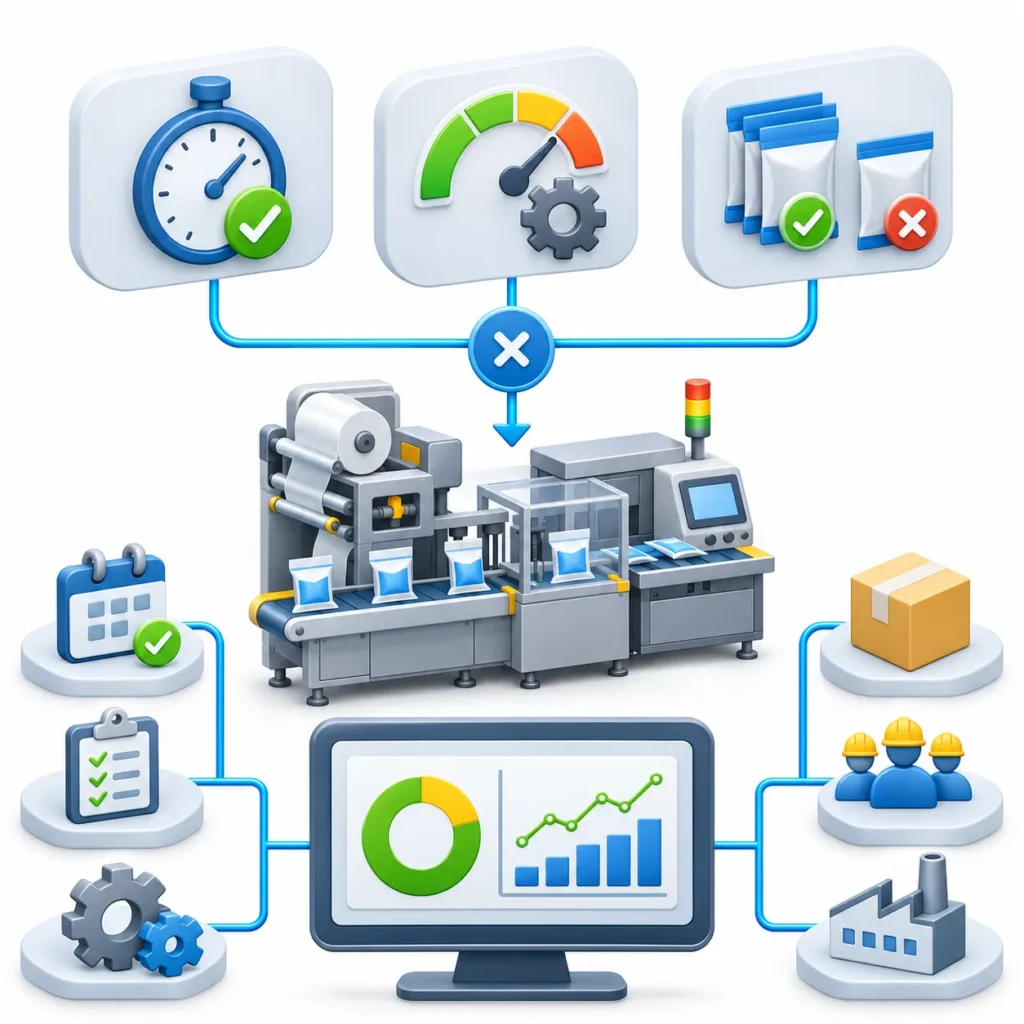
The Lean Enterprise Institute defines OEE as the product of three rates: availability, performance and quality. Availability measures losses from failures, adjustments and other downtime against scheduled time. Performance measures speed losses and short stoppages. Quality measures scrap and rework against total production. These rates are multiplied, not averaged, to produce OEE.
That distinction matters. A line can appear productive while losing time to frequent short stops. Another line can run at its target speed but create too much scrap. A single blended score can hide both problems unless the plant can drill into the underlying losses.
The first OEE challenge is therefore not dashboard design. It is data definition. The plant needs agreement on planned production time, run state, ideal cycle time, total count, good count, downtime reasons, changeovers and quality events. If one line treats a long setup as planned time and another treats it as downtime, comparisons become misleading.
Reliable data also needs context. A machine state without a product, work order, shift, recipe or reason code cannot explain why output changed. The goal is not to collect every possible tag. It is to collect the signals that support a decision and validate them before the dashboard becomes the official version of performance.
How IIoT improves availability, performance and quality
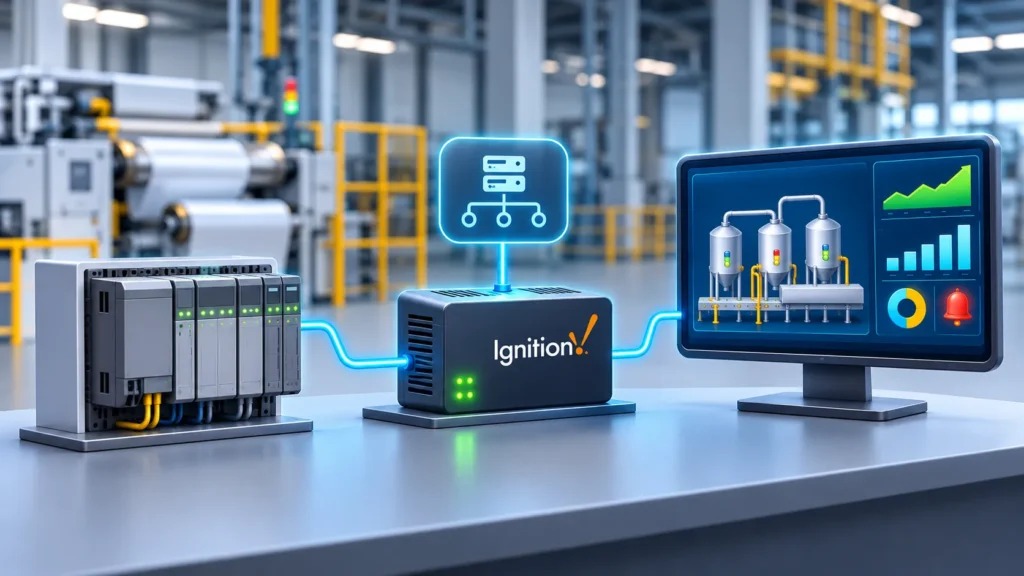
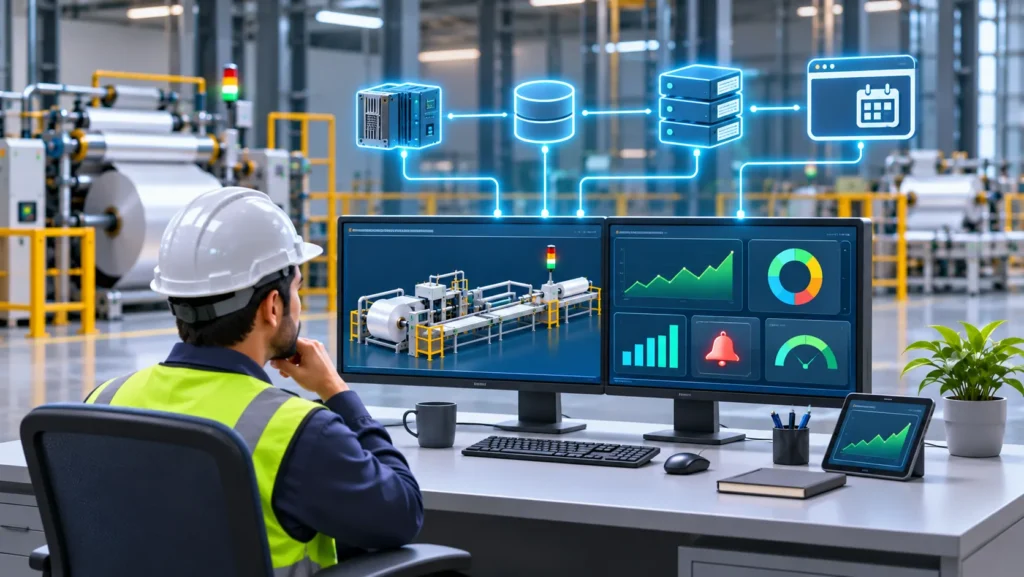
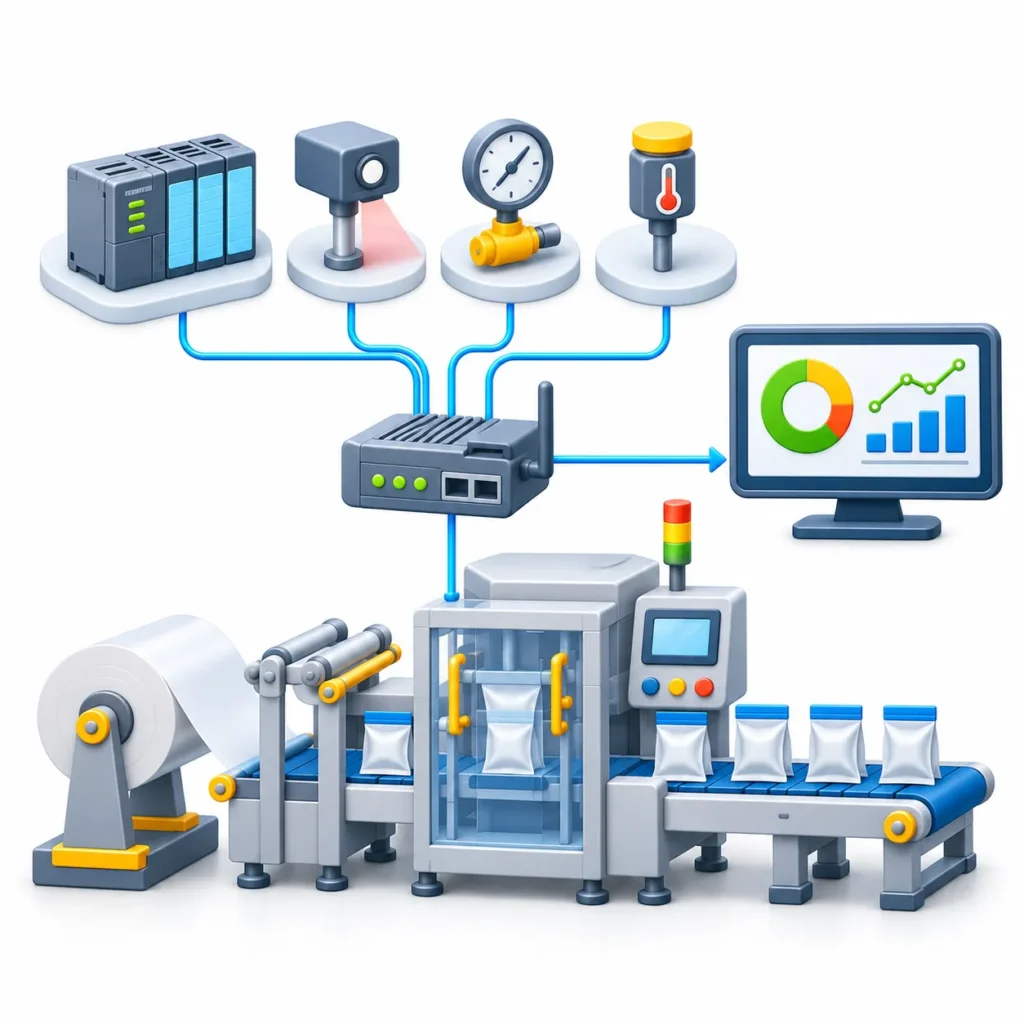
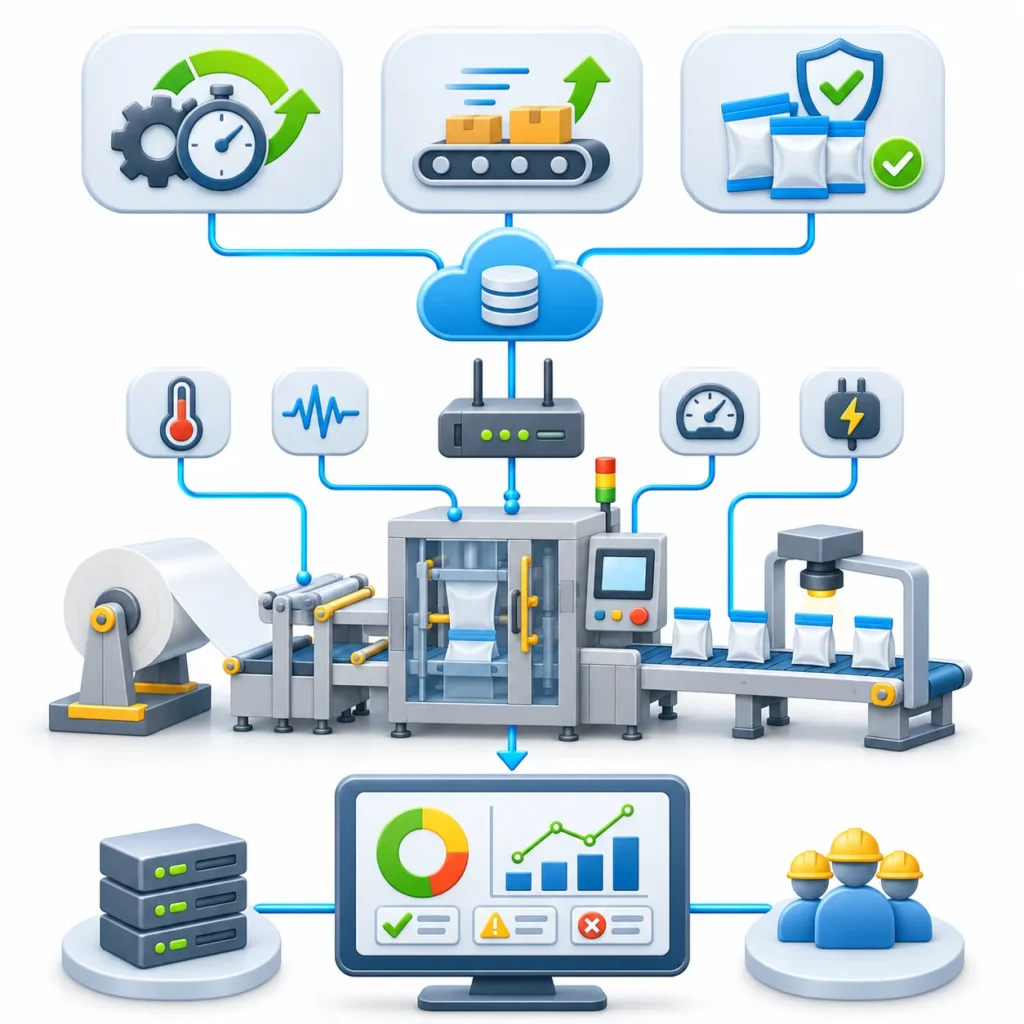
IIoT connects equipment, sensors, gateways and software so production data can move from the shop floor into systems that people can use. In a modern OEE architecture, a PLC or machine controller provides operating states and counts. Sensors can add measurements for vibration, temperature, pressure, energy or quality. An edge or gateway layer normalizes the data, and applications use it for monitoring, production tracking, analysis and alerts.
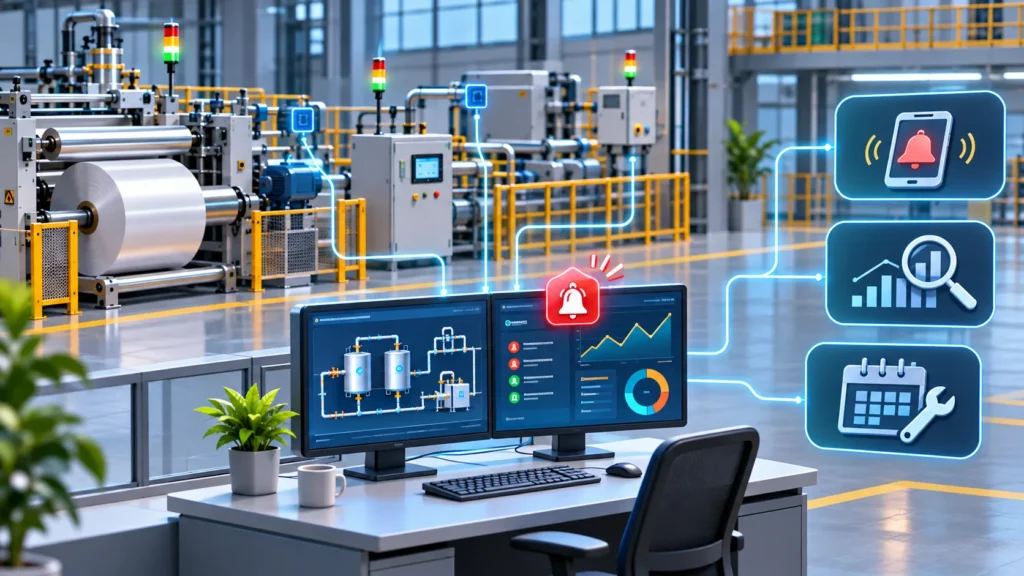
For availability, IIoT can make downtime visible as it happens. A stop signal can start an event, while operator input or a rules engine can classify the reason. This is more useful than discovering an unexplained loss in an end-of-shift spreadsheet. The classification still needs plant ownership. Automation can propose a reason, but operators and engineers must be able to correct it when the machine state does not tell the full story.
For performance, connected data can compare actual cycle time with the ideal cycle time for the product and operating condition. It can highlight speed losses, minor stops and bottlenecks that are easy to miss when only total output is reviewed. A line supervisor can then test whether the issue is a machine constraint, material delay, changeover method or upstream/downstream imbalance.
For quality, production counts need to be connected to good counts, defects and rework. When quality data is tied to the line, product, batch or work order, the team can look for relationships between process conditions and defects instead of treating scrap as a separate report.
Where Ignition fits in an OEE architecture
Ignition by Inductive Automation is positioned as a cross-platform industrial software platform for connecting plant-floor equipment, databases and applications. Its public platform material describes support for industrial connectivity, SQL, OPC UA, MQTT and web-deployed applications. In an OEE project, that makes Ignition a practical layer for collecting data, modeling equipment, building operator views, storing history and exposing dashboards.
The exact architecture depends on the plant. Ignition may sit above PLCs and gateways, connect to an MES, exchange information with an ERP, or feed a time-series and analytics layer. The important design question is not whether Ignition can display an OEE number. It is whether the implementation creates a trusted path from machine signal to operational action.
A useful design separates the layers:
- Connectivity: PLCs, sensors, drives, gateways and legacy-machine interfaces.
- Context: equipment hierarchy, products, work orders, shifts, recipes and reason codes.
- Calculation: availability, performance, quality, OEE, downtime, waste, MTBF and MTTR.
- Experience: operator screens, supervisor views, plant dashboards, alerts and reports.
- Action: escalation, maintenance response, root-cause analysis and continuous-improvement work.
This separation helps a plant change a dashboard without rewriting machine connectivity, and it makes the data model easier to reuse across lines or sites.
A practical implementation path for legacy and modern equipment
A plant does not need to replace every machine to begin improving OEE. A sensible rollout starts with an assessment of the current equipment, control systems, data quality and highest-cost losses.
nar dapibus leo.
Choose a line and define the loss model
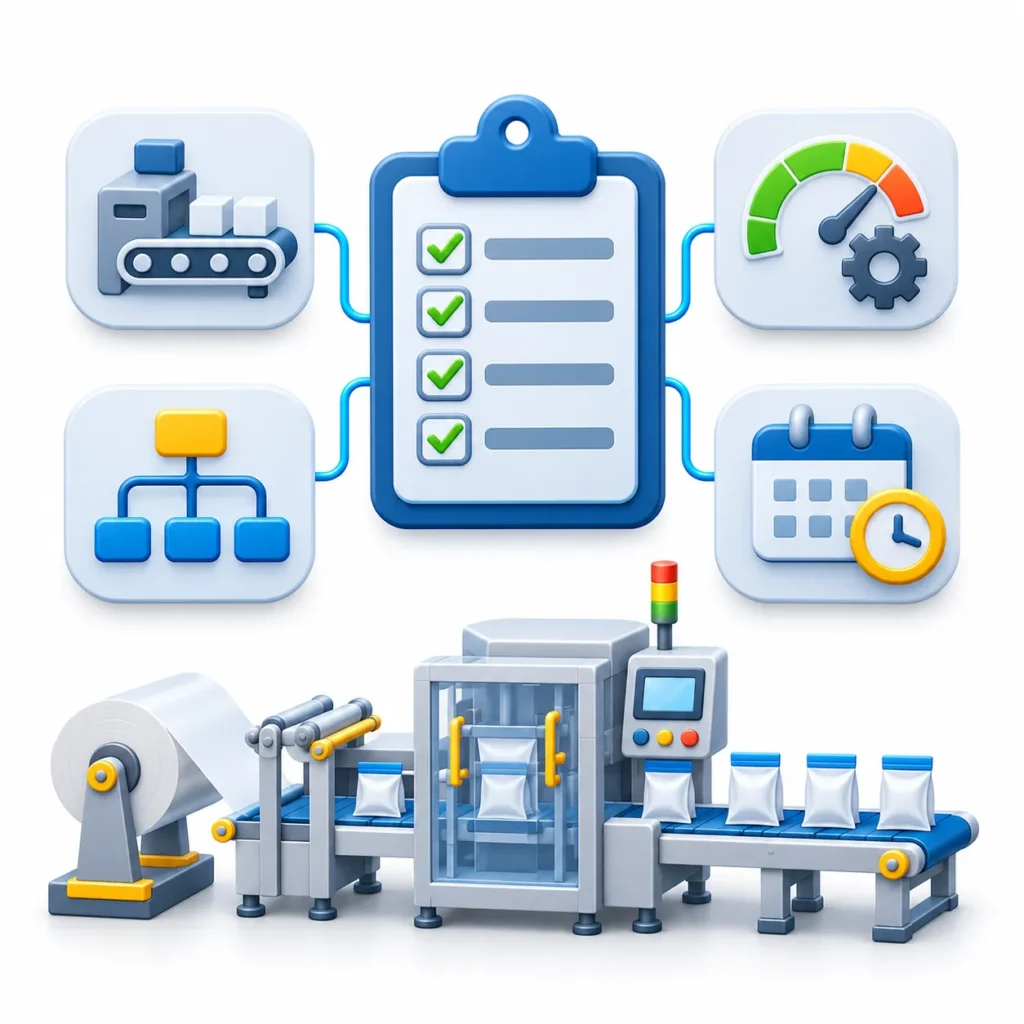
Start with a line where the business problem is clear. Agree on the OEE definitions, the equipment hierarchy and the reason-code structure before collecting data at scale. Decide which events must be automatic and where operator confirmation is needed.
Connect the highest-value signals
Instrument the machine states, production counts and quality inputs required for the first use case. Legacy equipment can often be connected through retrofit sensors, gateways or control-system interfaces. Do not add sensors simply because they are available. Add them when they answer a known operational question.
Validate the data before optimizing it
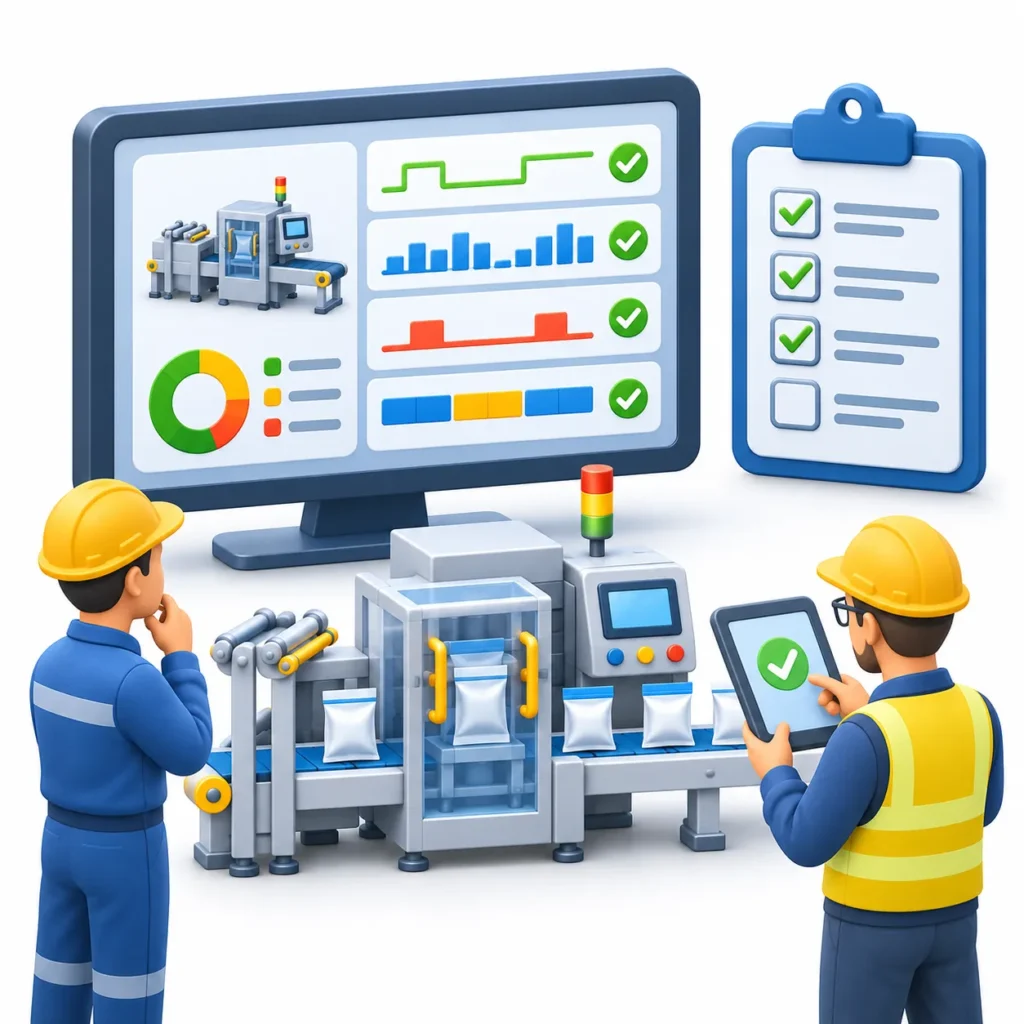
Compare system events with what operators see on the floor. Check clock synchronization, count accuracy, state transitions, downtime overlaps, product changes and shift boundaries. A technically elegant dashboard built on wrong states will reduce trust rather than improve performance.
Put the first decisions in front of operators
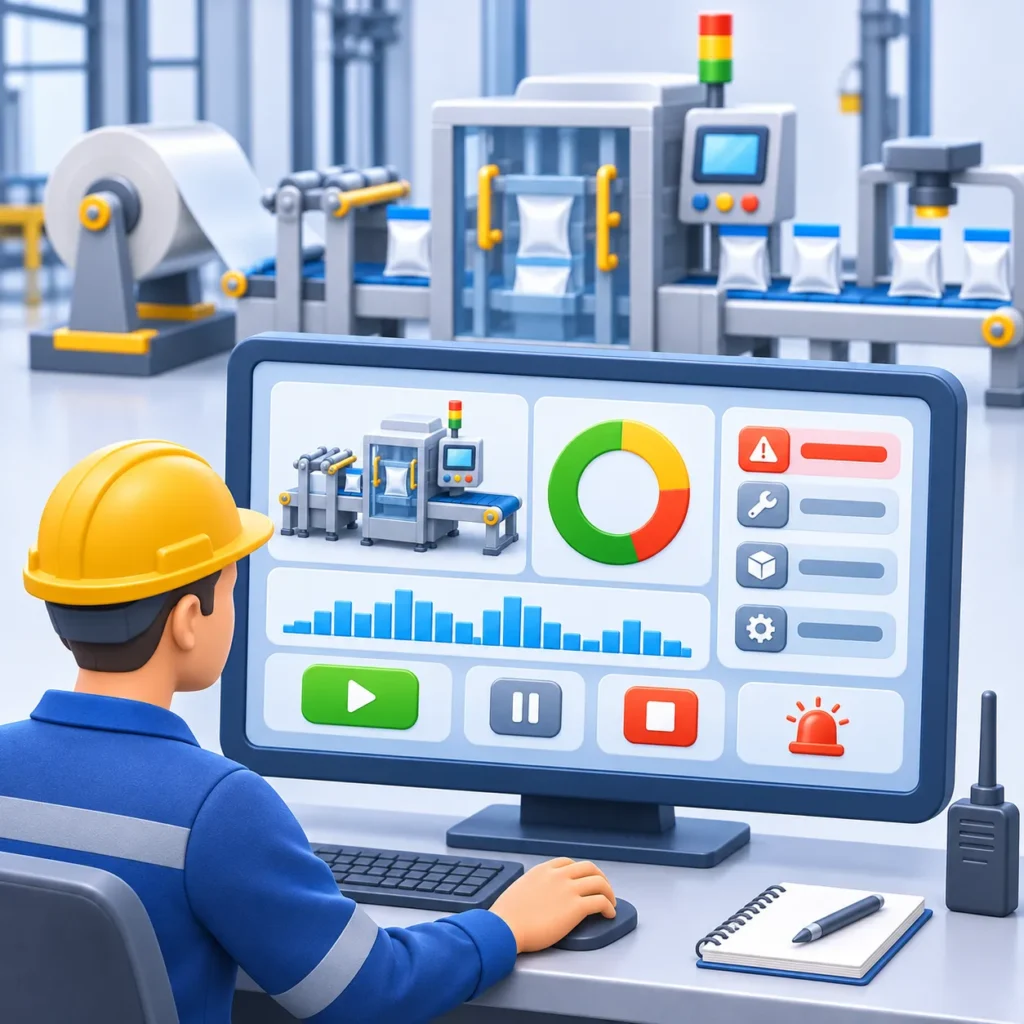
The first dashboard should help someone decide what to do next. Show current state, active loss, time elapsed, reason selection and escalation path. A plant-level score can come later. Adoption grows when the system helps the person closest to the process.
Expand from visibility to improvement
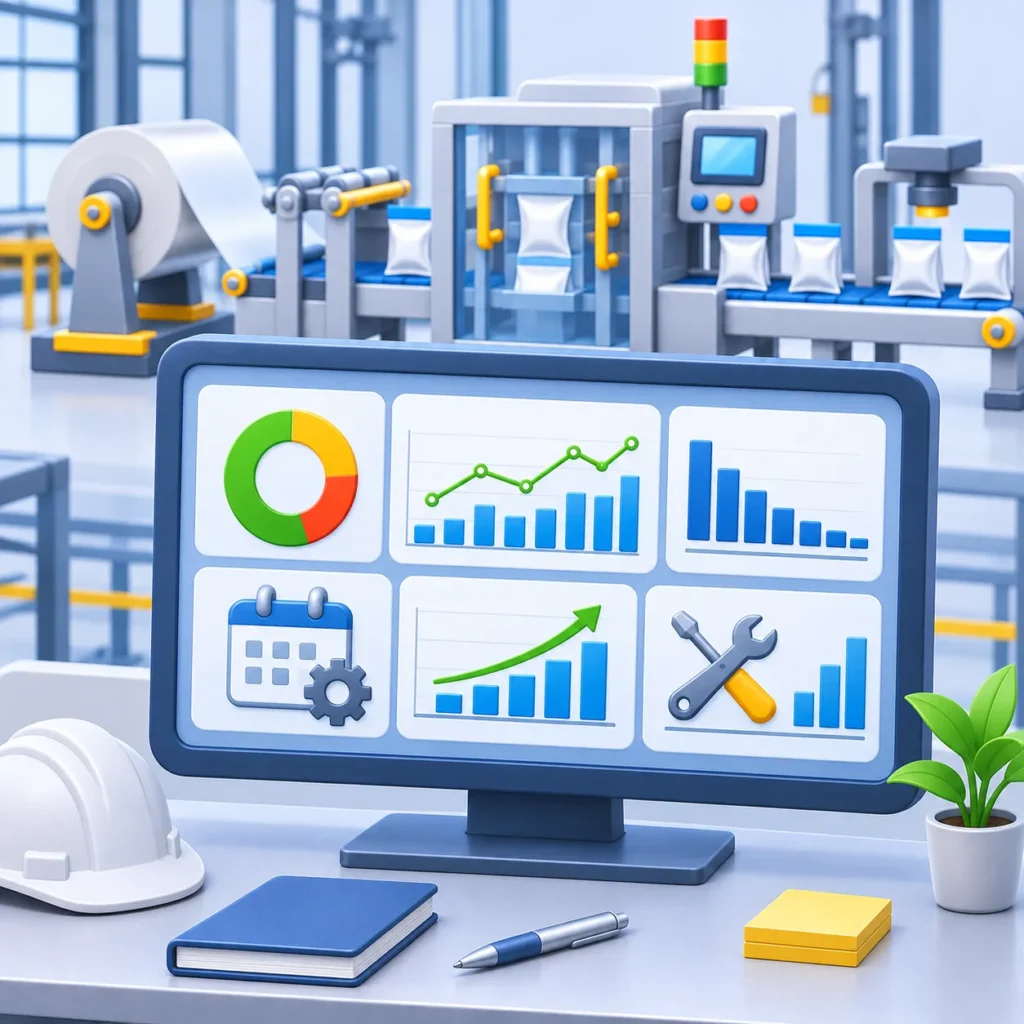
Once the data is trusted, add trend analysis, loss paretos, changeover analysis, quality relationships and maintenance signals. Connect improvement actions to the same production context so the team can see whether a countermeasure changed the loss.
How to turn OEE data into continuous improvement
OEE is a signal for investigation, not a target to manipulate. If teams are rewarded only for a higher score, they may change reason codes, hide planned losses or avoid recording quality problems. The better approach is to use OEE with the underlying losses and a clear review process.
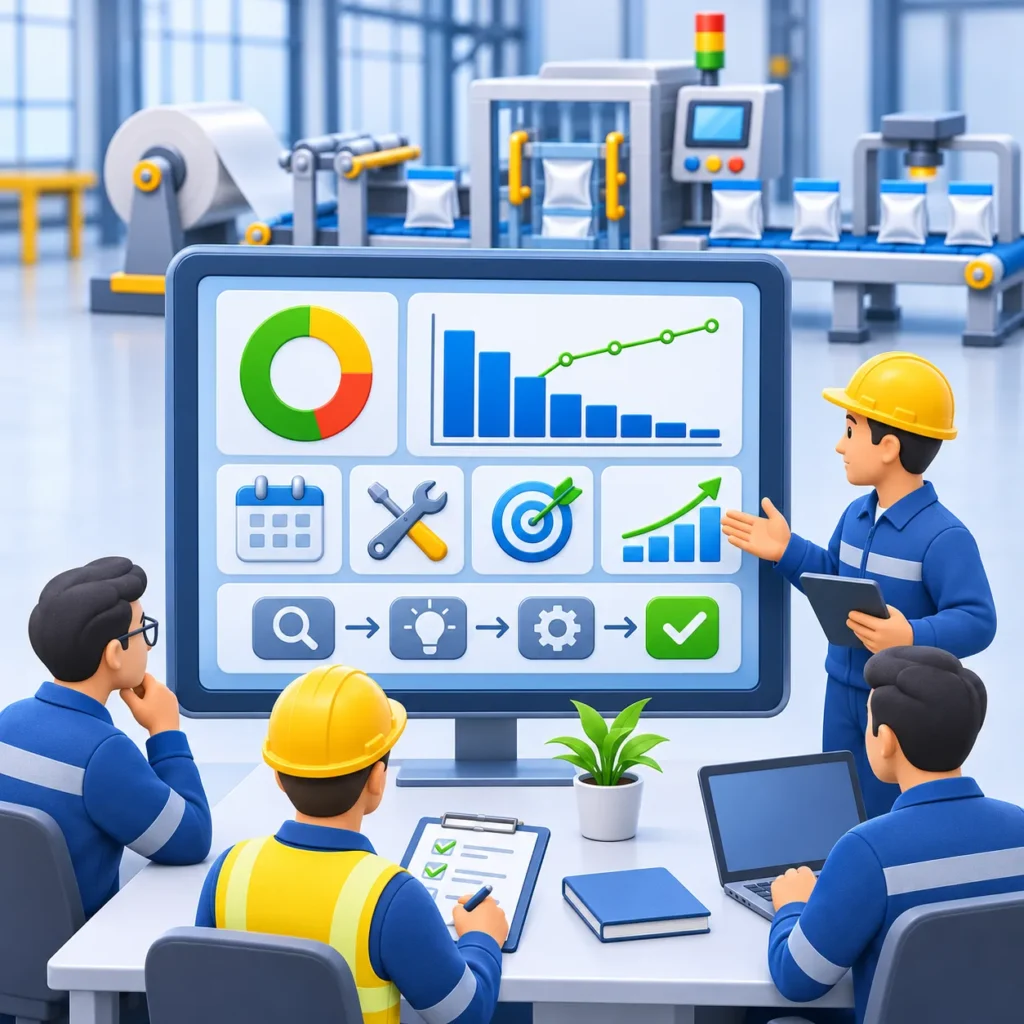
A weekly review can focus on the largest availability, performance and quality losses. For each loss, ask whether the problem is data quality, a one-time event, a repeatable process issue or a system constraint. Assign an owner, define the countermeasure and set a date to review the result.
Predictive maintenance can add value when the underlying production and equipment data is reliable. A vibration or temperature signal becomes more useful when it can be related to machine state, product, speed, load and maintenance history. The same principle applies to energy optimization and process analytics: context turns a sensor stream into evidence.
Microsoft’s 2022 IoT Signals manufacturing research reported that manufacturers viewed OEE as a leading smart-factory KPI and identified skills gaps as a major scaling challenge. The implication is practical: an OEE project needs frontline training
Common implementation mistakes to avoid
A plant can invest heavily in connectivity and still fail to improve OEE without a clear operating model. Start by defining downtime categories, production rules and measurement standards before building dashboards.
Operator input also matters. Machine data may detect a stoppage but cannot always identify its cause. Simple operator feedback helps capture accurate downtime reasons and production context.
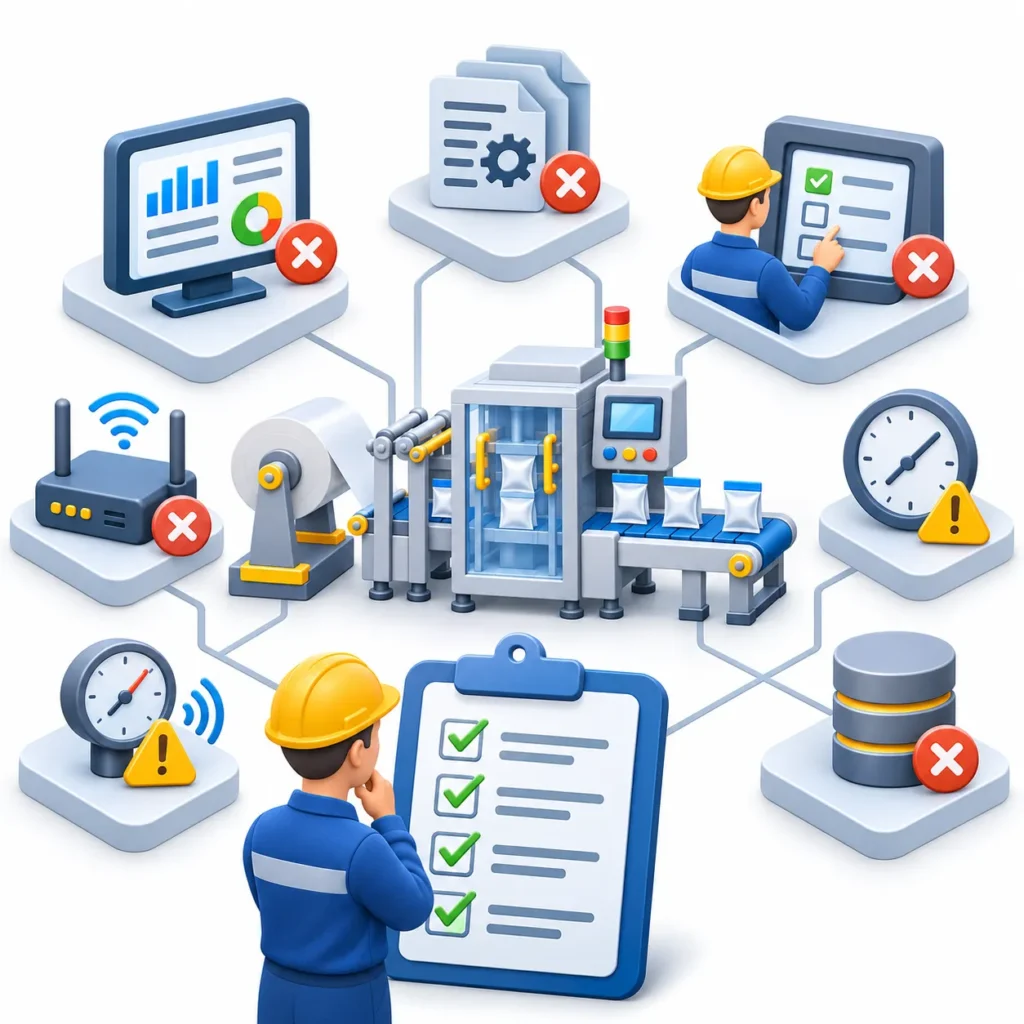
Plants must also account for network failures, sensor errors, clock differences and missing data to maintain reliable OEE measurements.
Finally, avoid scaling too early. Validate the first production line, establish a repeatable improvement process, and then expand the proven architecture across other lines.
How to evaluate an OEE and IIoT implementation partner
Ask potential partners to explain the full path from equipment to action. Useful questions include:
- How will you connect mixed PLC brands and legacy machines?
- How will you define planned time, downtime and ideal cycle time?
- Which values are automated and which require operator confirmation?
- How will the system handle product, work-order and shift context?
- Can the data be reused by MES, ERP, maintenance and analytics systems?
- How will you validate counts, states and time synchronization?
- What happens when the network or a gateway is unavailable?
- How will operators see and correct a wrong reason code?
- Can the architecture scale from one line to multiple plants?
- Who owns the data model, integrations and documentation after deployment?
Frequently Asked Questions
1. What is OEE in manufacturing?
Overall Equipment Effectiveness (OEE) is a manufacturing KPI that measures how effectively equipment is used during planned production time. It combines availability, performance and quality to identify production losses and opportunities for improvement.
2. How can manufacturers improve OEE?
Manufacturers can improve OEE by reducing unplanned downtime, minimizing machine speed losses, improving product quality and monitoring production performance in real time. Connected machine data and regular performance analysis help identify recurring problems and take corrective action.
3. How is OEE calculated in manufacturing?
OEE is calculated by multiplying three factors: Availability × Performance × Quality. Availability measures operating time, performance measures production speed against the ideal cycle time, and quality measures the proportion of products manufactured without defects.
4. How does Industrial IoT (IIoT) improve OEE?
Industrial IoT improves OEE by connecting machines, sensors and production systems to collect real-time operational data. This enables automated downtime tracking, production monitoring, performance analysis and faster identification of equipment inefficiencies.
5. Can Ignition SCADA be used for OEE monitoring?
Yes. Ignition by Inductive Automation can collect machine data, monitor production states, track downtime and visualize OEE metrics through configurable dashboards. It also supports integration with PLCs, databases, MES and other industrial systems.
6. How can manufacturers automatically track machine downtime?
Manufacturers can automate downtime tracking using PLC signals, machine sensors, industrial gateways and SCADA systems. These technologies detect machine stoppages, record downtime events and allow operators to assign reasons for production interruptions.
Conclusion
Improving OEE is not a matter of placing a percentage on a screen. It requires a trustworthy measurement model, reliable machine connectivity, useful context and a process that turns losses into actions. IIoT can connect modern and legacy equipment. Ignition can provide a flexible industrial platform for visualization, integration and application development. MES, analytics and maintenance systems can build on that foundation.
The best starting point is a focused line, a clearly defined loss model and a short list of decisions the plant needs to make faster. From there, a validated OEE architecture can expand into real-time production visibility, predictive maintenance, quality improvement and multi-site operations.
If your plant is unsure where the largest OEE losses begin, INGSOL can start with a Digital Transformation Maturity Assessment and map the connectivity, data and integration steps required for a practical rollout.
Contact our IIOT specialists directly:
Email: sales@ingsol.com
Phone (India): +91 95608 11774
Phone (US): +1 347 570 2629
Contact Us : CLICK HERE
Our engineers will review your current setup and outline a practical upgrade path built for your plant.