

How AI Is Transforming Flexo Printing & VFFS Quality Control
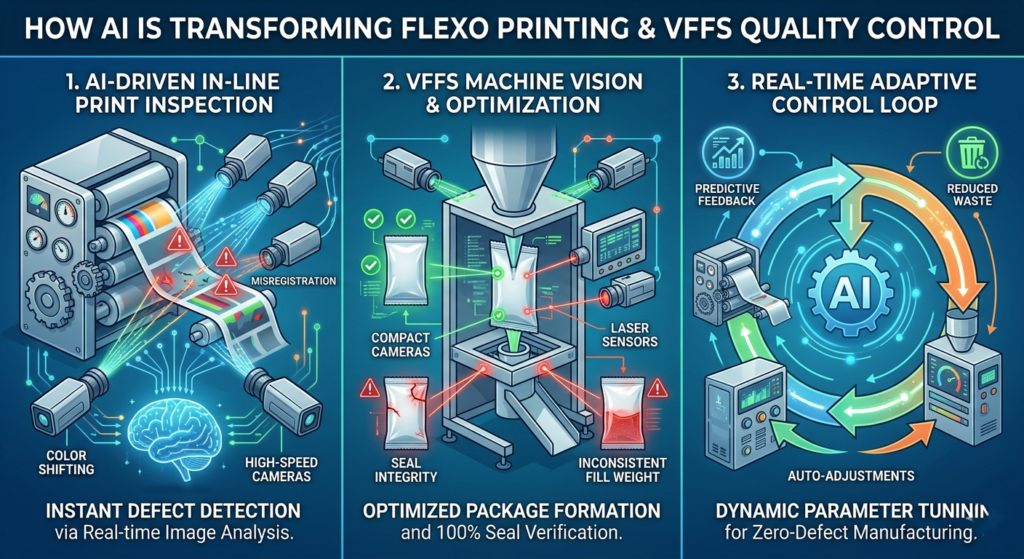
Artificial Intelligence is moving out of the experimental phase and onto the factory floor. Plant operators are increasingly integrating AI-powered predictive maintenance and real-time vision inspection systems onto High-Speed Flexo Printing Presses and Vertical Form Fill Seal (VFFS) machinery, drastically cutting web-downtime and minimizing material waste.
47%
Reduction in unplanned downtime via AI predictive analytics
40%
99.2%
$18M
The Problem AI Is Solving on the Production Line
Film extrusion and flexible packaging production have always operated on razor-thin margins. Every meter of wasted substrate, every unscheduled press stop, every misregistered print run chips away at profitability. Traditional quality control, reliant on periodic manual sampling and operator intuition, simply cannot keep pace with line speeds exceeding 400 metres per minute.
Enter Artificial Intelligence. By combining machine learning models with industrial sensor arrays, camera networks, and real-time process data, modern AI platforms can detect anomalies long before they manifest as visible defects or catastrophic equipment failure. The result: manufacturing operations that are faster, leaner, and measurably more profitable.
“The shift from reactive maintenance to predictive intelligence is the single biggest operational leap the flexible packaging industry has made in the past decade, and AI is the engine driving it.”
AI on High-Speed Flexo Printing Presses
High-Speed Flexo Printing Presses are complex, multi-unit machines where the failure of a single component, a doctor blade, an anilox roller bearing, or a UV lamp, can trigger a full web break and hours of costly downtime. Historically, maintenance was either calendar-based (wasteful and imprecise) or fully reactive (catastrophic and expensive).

How AI changes the equation
AI-powered predictive maintenance systems continuously monitor vibration signatures, temperature gradients, ink viscosity fluctuations, and motor current draws across every critical press unit. Machine learning models trained on thousands of historical fault events can recognise the subtle precursors of failure up to 72 hours in advance, giving maintenance teams a precise, actionable window to intervene without stopping production.
According to industry leaders, including Nilpeter, Omet, and Bobst, flexible packaging now represents more than 40% of all flexo-produced packaging, making press uptime directly tied to business survival. As Nilpeter’s global head of marketing states:
“Flexo today is no longer a mechanical discipline alone; it is increasingly software-driven. Automation has moved from being a competitive advantage to becoming an operational necessity.”
- Vibration analysis on anilox rollers detects bearing wear before audible noise develops
- Thermal imaging cameras flag UV curing unit degradation in real time
- Ink rheology sensors feed ML models that predict viscosity drift and colour shift
- Digital twin simulations model press behaviour under varying substrate and speed conditions
- Automated work-order generation routes alerts directly into CMMS and ERP platforms
- AI-driven colour tuning and closed-loop spectral control reduce makeready time by 30–70%
Before AI Integration
Calendar-based PM schedules, reactive repairs, manual colour checks, 30-min average job setup, unpredictable downtime events.
After AI Integration
72-hour failure prediction window, automated press setup in ~4 minutes, closed-loop colour control, 47% downtime reduction.
Real-Time Vision Inspection on VFFS Machinery

Vertical Form Fill Seal machines operate at the convergence of film handling, forming, filling, and sealing four distinct process zones where defects can originate. A seal contaminated by product, a film with a micro-perforation, a misaligned print register: any one of these can reach the end consumer and trigger a costly product recall.
The numbers are stark: 45.5% of U.S. food recalls in 2024 were caused by label and packaging errors, costing an estimated $1.92 billion in losses. Over 50% of pharmaceutical product recalls trace back to labelling or packaging defects, with the average recall costing $10 million per incident, excluding long-term brand damage.
How AI vision systems close the inspection gap
Modern AI-powered vision inspection platforms deploy multi-camera arrays at each critical zone of the VFFS line. Deep learning models trained on tens of thousands of labelled defect images classify anomalies in under 10 milliseconds, triggering automated rejection before the defective pack ever reaches the downstream conveyor or the end consumer.
A 2024 study by the American Society for Quality confirmed that state-of-the-art AI inspection systems can detect surface defects as small as 0.1mm with 99.8% accuracy, surpassing the theoretical maximum performance of human inspectors. In controlled testing, AI systems detected 37% more critical defects than expert human inspectors working under optimal conditions.
- Seal integrity inspection detects contamination, cold seals, and incomplete welds at full line speed
- Print register verification catches misalignment below a 0.1mm threshold beyond human visual capability
- Film surface inspection identifies pinholes, gels, and fish-eyes in real time
- Fill-level verification through X-ray or NIR integration confirms product dose accuracy
- Automated SPC data logging builds a statistical quality record for every production batch
- Food producers report a 22% average reduction in customer complaints after AI inspection implementation
“AI vision systems do not get fatigued at hour six of a shift. They do not have blind spots on the edges of a 1,200mm web. They deliver consistent, documentable quality data that manual inspection simply cannot match.”
Cutting Web Downtime: The Compounding ROI of AI

Web downtime on a flexo press is not a linear cost. Every stop triggers a cascade: substrate waste during threading, ink flushing, register re-establishment, and the inevitable quality checks before restarting at speed. A single unplanned 90-minute stop on a high-speed press can cost upwards of ₹3–5 lakh when substrate waste, labour, and lost throughput are fully accounted for.
AI systems that prevent even two or three such stops per month deliver ROI that typically recaptures the full technology investment within 12–18 months, an exceptional payback period by any capital expenditure benchmark. The global AI in packaging market, valued at $2.62 billion in 2024, is on track to reach $4.49 billion by 2029, reflecting the accelerating pace of adoption as return on investment becomes impossible to ignore.
Material Waste Reduction: The Sustainability Dividend

Flexible packaging manufacturers are under increasing pressure from brand owners and regulators to demonstrate progress on material efficiency and sustainability. AI-driven quality control directly addresses this imperative by detecting defects in-line and at source, rather than at the slitter-rewinder or, worse, at the customer’s premises. AI eliminates the compounding waste of downstream rework.
Every roll that passes inspection on the first run is a roll that does not require re-extrusion, re-lamination, or disposal. The sustainability dividend compounds: less energy consumed in rework, fewer raw materials extracted, lower carbon footprint per unit of finished packaging. AI analyses lifecycle data to suggest greener alternatives, thinner recyclable films, and redesigned carton configurations that use less board.
Waste Reduction Impact
AI real-time defect detection reduces material waste by up to 40%, directly cutting raw material consumption and energy used in rework cycles.
Customer Quality Gains
Food producers using AI vision inspection report a 22% average reduction in customer complaints linked to product quality or packaging defects.
What Plant Operators Need to Know Before Integrating AI

AI is not a plug-and-play solution. Successful integration requires thoughtful preparation across four critical areas, and INGSOL recommends a phased approach that minimises disruption to ongoing production.
1. Data Infrastructure Audit
AI models are only as good as the data they learn from. Plants need to audit their existing sensor coverage, historian systems, and data pipeline architecture before selecting an AI platform. Connectivity gaps uncovered sensors, legacy PLCs without data output, must be resolved at the foundation level.
2. Edge Computing for Real-Time Inference
Real-time inference at line speed demands ultra-low-latency processing. Most modern implementations deploy edge computing hardware directly at the machine rather than relying on cloud round-trips. This keeps response times in the sub-10ms range required for inline rejection systems.
3. Operator Training and Change Management
The most sophisticated AI vision system delivers zero value if operators do not trust or understand its alerts. Structured change management, including hands-on training and a transparent alert logic explanation, is non-negotiable for sustainable adoption.
4. MES and CMMS Integration
AI alerts must flow seamlessly into existing Manufacturing Execution Systems and Computerised Maintenance Management Systems to drive real operational action. An AI alert that sits in a standalone dashboard disconnected from the maintenance workflow will never reach its potential.
How INGSOL Supports Your AI Integration Journey
INGSOL brings decades of hands-on expertise in flexible packaging machinery from blown film lines and flexo presses to lamination units and VFFS systems. Our engineering and process teams work alongside AI technology partners to assess your specific line configuration, identify the highest-value integration points, and design a phased implementation roadmap that minimises disruption to production.
Whether you are evaluating predictive maintenance for an existing press fleet, implementing inline vision inspection on a new VFFS installation, or building a data strategy for a greenfield packaging plant, INGSOL has the domain knowledge to translate AI capability into measurable manufacturing outcomes.
Reference:
gitnux.org/ai-in-the-printing-industry-statistics
shinkomachinery.com — Future Trends in Flexo Printing
packagingworldinsights.com — AI-Driven Workflows
jidoka-tech.ai — AI Packaging Inspection Quality Control