
Unified Namespace

Unified Namespace: One Source of Truth for Your Factory's Data
Most factories run too many integrations to count easily. Point-to-point connections link PLCs, SCADA, MES, historians and ERP. Each connection serves one purpose. Each is also a potential failure point. A Unified Namespace replaces that tangle with one source of truth. Every authorised system can then draw from it in real time. This page explains what a Unified Namespace is. It also shows why it matters for factories everywhere. Finally, it explains how INGSOL designs and builds one.
What Is a Unified Namespace?
A Unified Namespace, or UNS, is a centralised data structure. It represents the current state of your entire operation. This spans individual sensors, machines, lines, plants and the enterprise. Instead of systems querying each other directly, they publish to the namespace. Each system then subscribes to the Unified Namespace data it needs. This typically runs through an event-driven broker, such as MQTT.
However, a Unified Namespace is not simply a bigger database. It also does not replace your SCADA, MES or ERP systems. Instead, it is an architecture. It gives you one consistent, real-time model of your operation. As a result, any system finds the same data in the Unified Namespace. No one needs a bespoke integration for each connection.

Why Point-to-Point Integration Breaks Down
Most plants arrive at their current data architecture gradually, adding a connection whenever a new system needs information from another. Over time, this produces a familiar set of problems:
INTEGRATION COMPLEXITY MULTIPLIES
Every new system requires its own custom connection to every other system it needs data from, and the number of connections grows far faster than the number of systems.
INCONSISTENT DATA
The same piece of data, a tank level, a production count, a machine status, may be defined, formatted or timed differently across each point-to-point connection
FRAGILE TO CHANGE
A change to one system’s data format can silently break every direct connection built against it, often discovered only once a report or dashboard shows incorrect figures.
SLOW TO EXTEND
Adding a new dashboard, analytics platform or AI model means building yet another custom connection back to every relevant source system.
How a Unified Namespace Is Structured
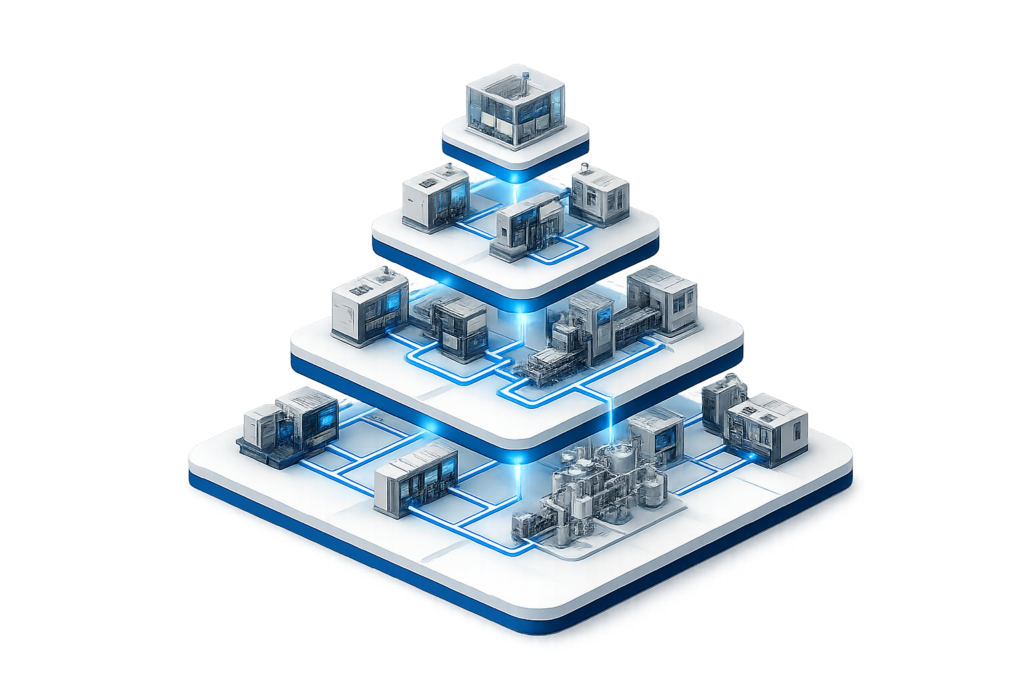
INGSOL designs each Unified Namespace around a clear, hierarchical model. This usually aligns with the ISA-95 standard. The structure follows enterprise, site, area, line and equipment. Each piece of data occupies a defined spot in this hierarchy. It publishes in real time as it changes. Therefore, any system can find data by its logical position. It no longer needs to know which system produced it first.

How INGSOL Implements a Unified Namespace

Data and Systems Audit
INGSOL begins with a data and systems audit. We map your existing PLCs, SCADA, MES, historians and ERP. This shows what data each system holds. It also reveals how that data moves today. In addition, it highlights where duplication occurs.
Namespace Design
Next, INGSOL designs the Unified Namespace hierarchy. We build it around your specific operation. Naming conventions follow ISA-95 or an equivalent model. As a result, the structure reflects how your plant actually works.
Broker and Protocol Implementation
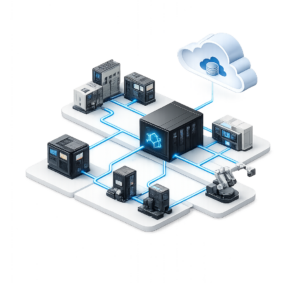
INGSOL then implements the namespace using an MQTT broker. We commonly use the Sparkplug specification for structured messaging. This connects with platforms such as Ignition and ThingsBoard. Existing PLCs and SCADA link in through OPC UA, Modbus, EtherNet/IP or PROFINET. Therefore, legacy equipment can publish into the namespace. It never needs replacement to do so.

Consuming Applications
Once data flows into the Unified Namespace, applications can subscribe to it. Dashboards, historians and analytics platforms all draw from the Unified Namespace. AI models can subscribe too. Teams can add new applications this way. They avoid building a new connection to each source system.

Governance and Security
Finally, INGSOL defines clear governance for the Unified Namespace. We set ownership and access control for each part. As a result, teams access only the data relevant to their role. The wider architecture stays protected.
Unified Namespace, SCADA, MES and IIoT
A Unified Namespace does not replace SCADA, MES or your IIoT platform. Instead, it changes how they exchange data. SCADA still handles real-time process control. MES still manages production orders and quality. IIoT platforms still manage device connectivity. However, each one now publishes to and reads from the namespace. This replaces separate, direct connections between every system in the Unified Namespace. That is why INGSOL builds Unified Namespace architecture within our Communication and Integration work. We use the same open protocols across SCADA, MES and IIoT.

Why Manufacturers Choose INGSOL for Unified Namespace
Open architecture:
INGSOL's Unified Namespace runs on open standards, including MQTT, Sparkplug and OPC UA. Therefore, your namespace never depends on one proprietary platform.
Works with existing systems:
legacy PLCs and SCADA systems publish through existing protocols. As a result, you avoid a wholesale system replacement.
Faster to extend:
A new dashboard or AI model connects to the Unified Namespace once. It does not need a fresh integration to every source system.
Reduced integration debt:
This lowers your long-term integration debt. In addition, the Unified Namespace reduces the number of custom interfaces to maintain.
Part of a complete architecture:
INGSOL delivers this work within a wider capability. This spans Digital Transformation, Communication and Integration, and Data and Intelligence. Therefore, it supports your full architecture, not just one piece.
Where to Start
INGSOL typically introduces a Unified Namespace during a Digital Transformation Maturity Assessment (DTMA). We first evaluate your current OT infrastructure and integration approach. Then, we design a Unified Namespace structure suited to your plant. Implementation usually starts with one production line or area. It then extends across the plant as the structure proves its value.

INGSOL designs Unified Namespace architectures that give factories one real-time view. This view simplifies integration as your systems evolve. Contact us to discuss a Unified Namespace for your plant. Alternatively, start with a Digital Transformation Maturity Assessment.
Our Clients














membership